બેતાલીસે બેતાળાં Comes for All of Us. Be the Healthiest You Can at Your Age
Whatever you do, you can't halt or reverse the ageing process...the best example being the બેતાલીસે બેતાળાં

Audio and YouTube versions available at the end of this email.
In my last piece on ageing, I had quoted Felipe Sierra’s [1] definition of ageing.
“Ageing is basically the accumulation of macromolecular damage, which occurs due to extrinsic and intrinsic insults but without 100% efficiency of the repair process as we become older. Why does the repair process become inefficient? This is likely a function of our evolution and the process of natural selection, which probably decreed over the last 100,000 years or more that humans are good to live till around age 60-70 and then it doesn’t really matter, which is when the resilience of the body starts dropping.”
 Bhavin Jankharia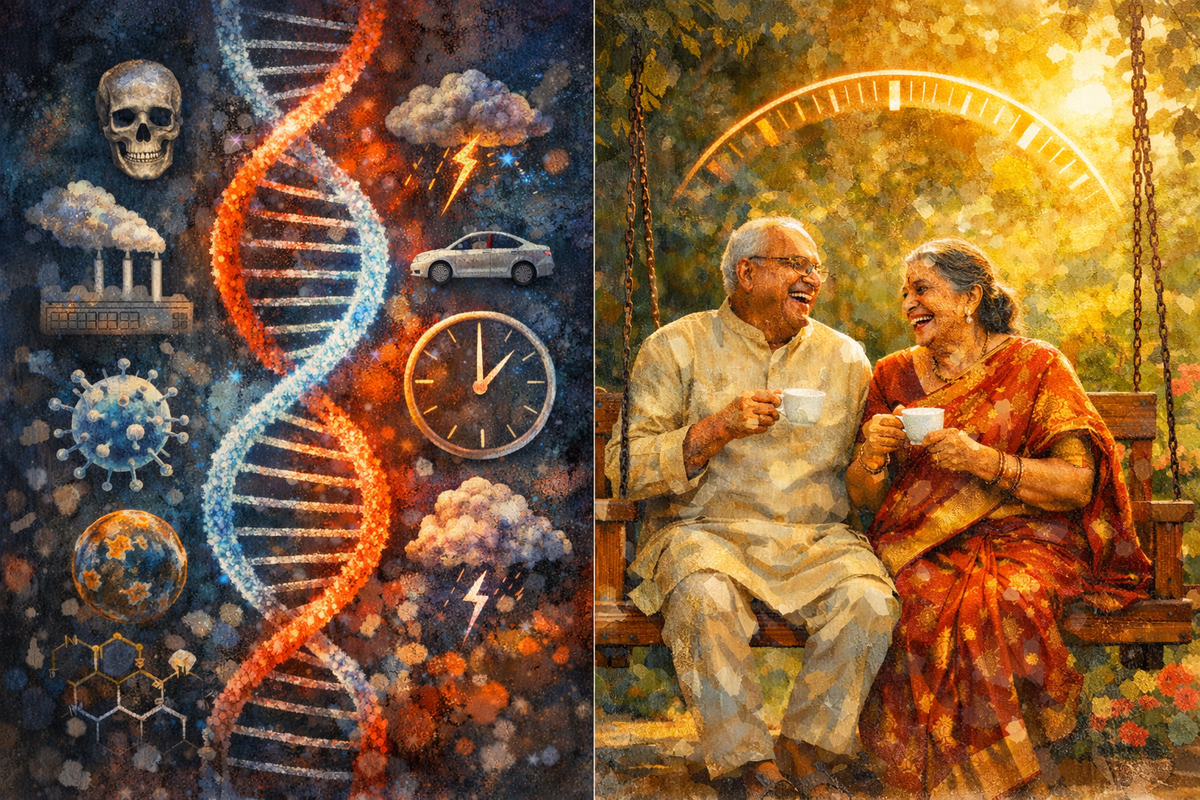
What all the longevity gurus don’t really get is that while lifespan could perhaps be extended by a few years, you cannot bring back the vitality of mind and body of the earlier decades, especially the 20s and 30s.
This was starkly evident when after watching the movie Michael, I spent the next hour or so at home going through MJ’s old videos on YouTube. The MJ in his 20s was a very different person from MJ in his 40s…reduced energy, reduced vitality…which are uniform issues across all professions. You can see that in actors…compare the energy of a young Shahrukh Khan in his 20s and 30s to the controlled version we see now, or young resident doctors who can actually work 48 hours and some more and still have the energy to party after that to doctors in their 50s and 60s who need to rest and sleep and recuperate and can barely if at all work 10-12 hours at a stretch.
બેતાલીસે બેતાળાં (Betalise betaalaa) is a Gujarati phrase that loosely translates to “betaalaa at forty-two”. “Betaala” is a single word to describe a biological event - the dimness of vision that arrives around age 42 due to presbyopia. Whatever you do, however much you run, workout, eat sensibly, sleep well, take your vaccines, not smoke, go in for foo-foo medicine interventions such as intravenous vitamin drips or hyperbaric oxygen, you will, around the age of 42 start needing spectacles.
There are some predictable epochs in our lives that we are destined to go through, irrespective of what we do. In Aug 2024, Xiaotao Shen and colleagues at Stanford [2] published a paper in Nature Aging that tracked tens of thousands of molecules in 108 people followed longitudinally. They found two major epochs, at ages 44 and 60.
Around 44 — betaalise betaalaa age — there is a sharp dysregulation in cardiovascular function, lipid metabolism, alcohol metabolism, caffeine metabolism, and the structural integrity of skin and muscle. The hangovers last longer. The skin recovers slower from injury and cuts. The lipid panel starts misbehaving. The body that absorbed punishment in the 30s starts sending invoices. And, of course, the eyes get their chashmas (spectacles).
Around 60 is the second cliff. Immune regulation falls off. Carbohydrate metabolism shifts. The risk of cardiovascular disease, type 2 diabetes, and kidney disease climbs steeply, not gradually. Infections that were minor at 50 can become hospitalisations at 65.
The same is true of brain function. In November 2025, Alexa Mousley and colleagues at Cambridge and Pittsburgh published in Nature Communications what is probably the clearest map yet of how the human brain ages [3]. On diffusion MRI scans from over 4,000 people aged zero to 90, they identified four sharp turning points: at roughly 9, 32, 66, and 83 years.
The most important, for our purposes, is 32. From around 9 to around 32, the brain becomes more efficient, more integrated, more globally connected. Information moves faster across shorter paths. After 32, the trajectory reverses — integration begins to decrease, the network fragments into more locally clustered subunits. The authors call 32 the strongest topological turning point of the lifespan.
This aligns with what we have always known. Intelligence test scores plateau around 30. Personality stabilises around 30. Athletic peak performance is typically before 30. Sachin Tendulkar made his Test debut at 16, was at his prolific best through his late 20s, and retired at 40 when his body would no longer cooperate.
Even the most aggressive longevity science only stretches lifespan modestly; it cannot reset these curves. The brain will still peak at 32. The body will still hit its cliffs at 44 and 60. We can buy a few more years. We cannot buy back our 20s.
What does this mean for you and me?
Whatever we do, we can’t reverse the ageing process, both of the body and the mind. Whatever we do, we can’t even halt or pause the march of ageing. We have to embrace the fact that at 60, we can’t think or behave like 20-year olds…their energy, their ability to work and play are at levels, we can no longer comprehend, forget emulating.
What we can though do is aim to be the healthiest versions of ourselves at our age. Each 60-year old person is not the same. If you are physically active, eating sensibly, sleeping well, not smoking, drinking alcohol within limits, taking your vaccines, controlling your syndemic risks (high blood pressure, high blood sugar, high lipid levels, extreme obesity), adjusting your days based on the environment around you (air pollution, heat, cold), screening for those diseases where screening makes a difference and making sure you don’t fall, you will be a completely different animal from someone who doesn’t do these things or does just a few.
The ageing process is inevitable…we can’t halt it, we can’t reverse it…at best we can slow it a bit but most importantly, aim to be as healthy as possible for our age, which is possible as the atmasvasth guide shows. We will be happier, if rather than fighting our age, we embrace it and act accordingly.
 Bhavin Jankharia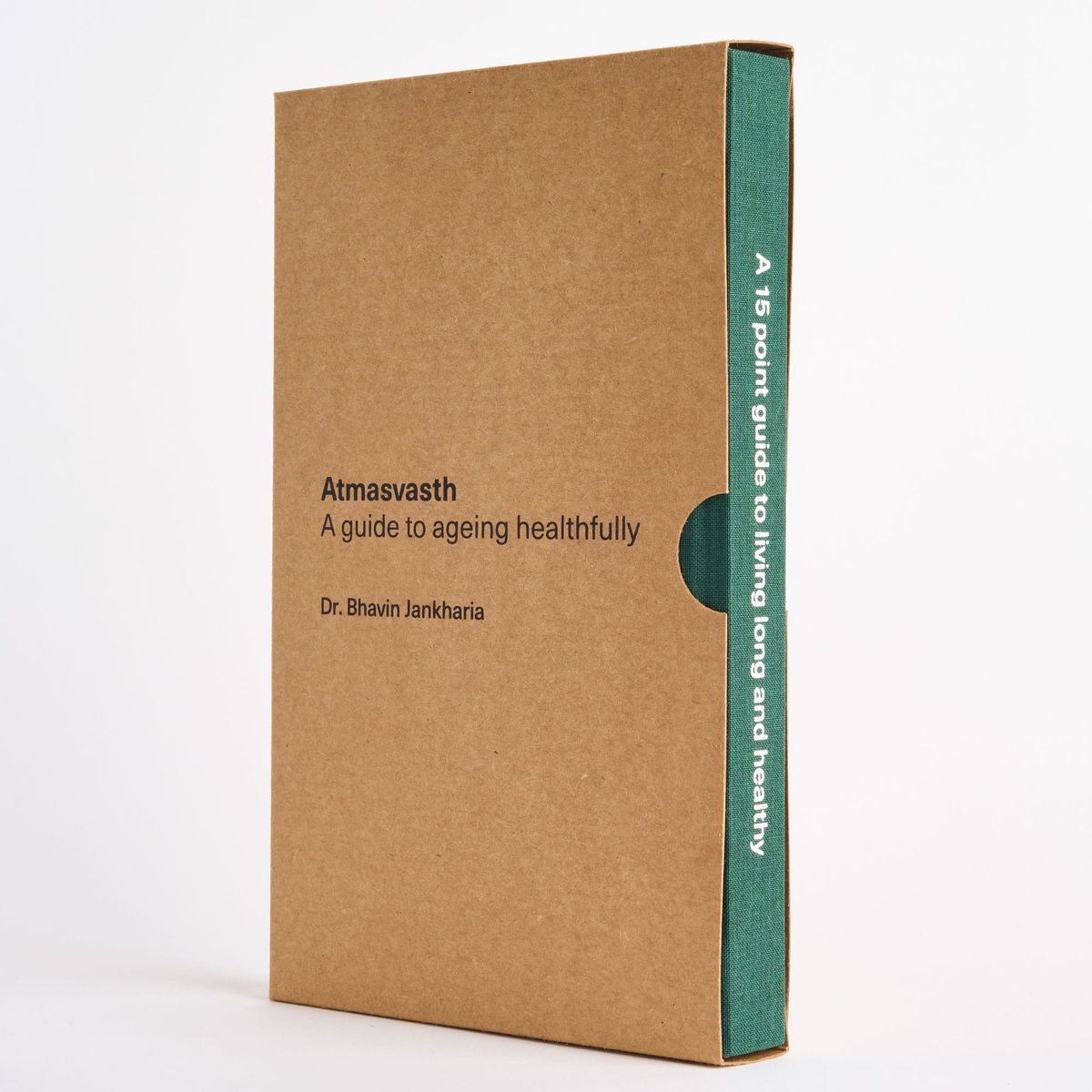
Listening Options
Audio File
YouTube
Footnotes
1. Sierra F. Are we getting closer to understanding why we age? Nat Aging. 2025 Oct;5(10):1915-1916. doi: 10.1038/s43587-025-00969-0. PMID: 40935855.
2. Shen, X., Wang, C., Zhou, X., Zhou, W., Hornburg, D., Wu, S., & Snyder, M.P. (2024). Nonlinear dynamics of multi-omics profiles during human aging. Nature Aging. https://doi.org/10.1038/s43587-024-00692-2.
3. Mousley, A., Bethlehem, R.A.I., Yeh, F.-C., & Astle, D.E. (2025). Topological turning points across the human lifespan. Nature Communications, 16:10055. https://doi.org/10.1038/s41467-025-65974-8
The Book
 Bhavin Jankharia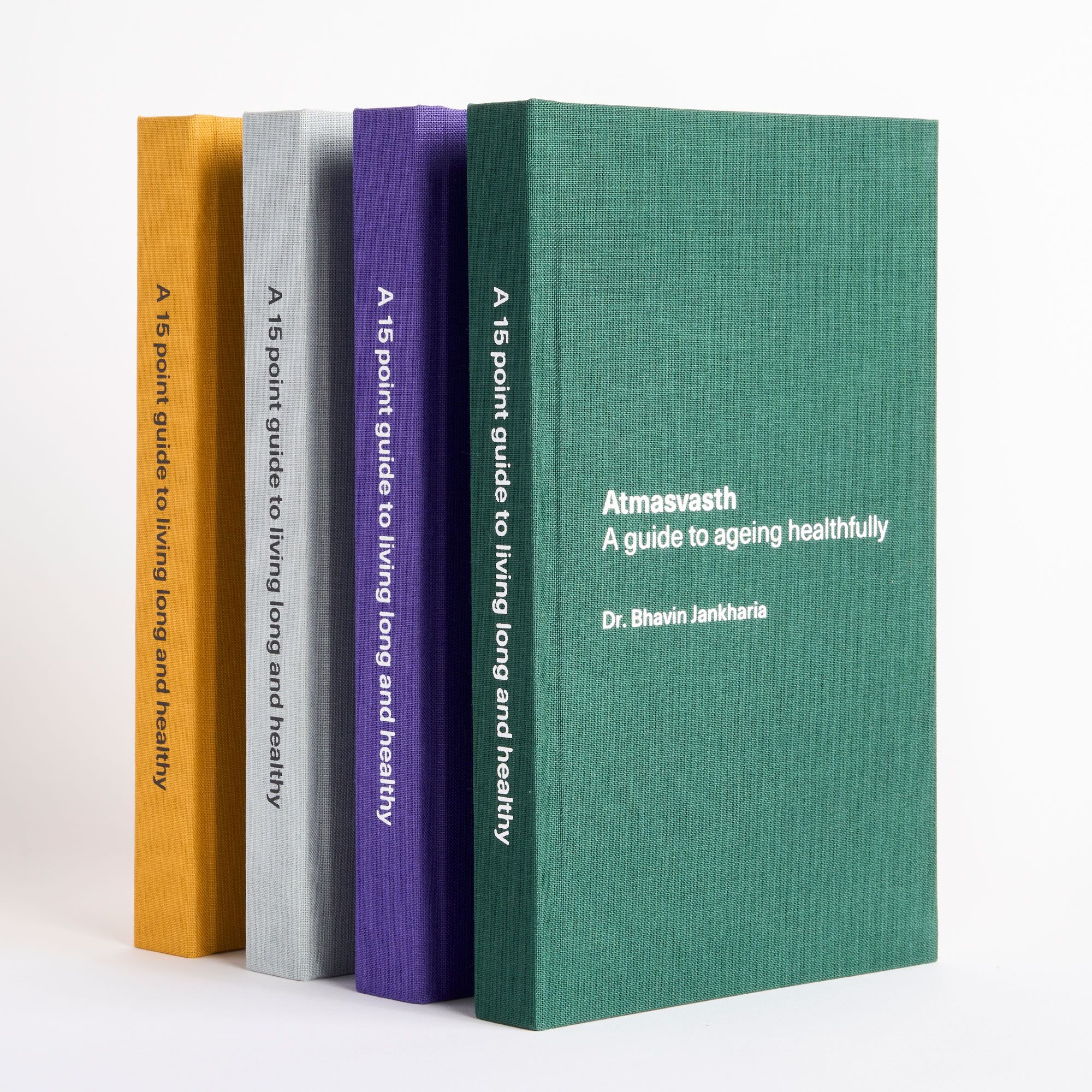
The Detailed 15-Point Guide to Live Long, Healthy
 Bhavin Jankharia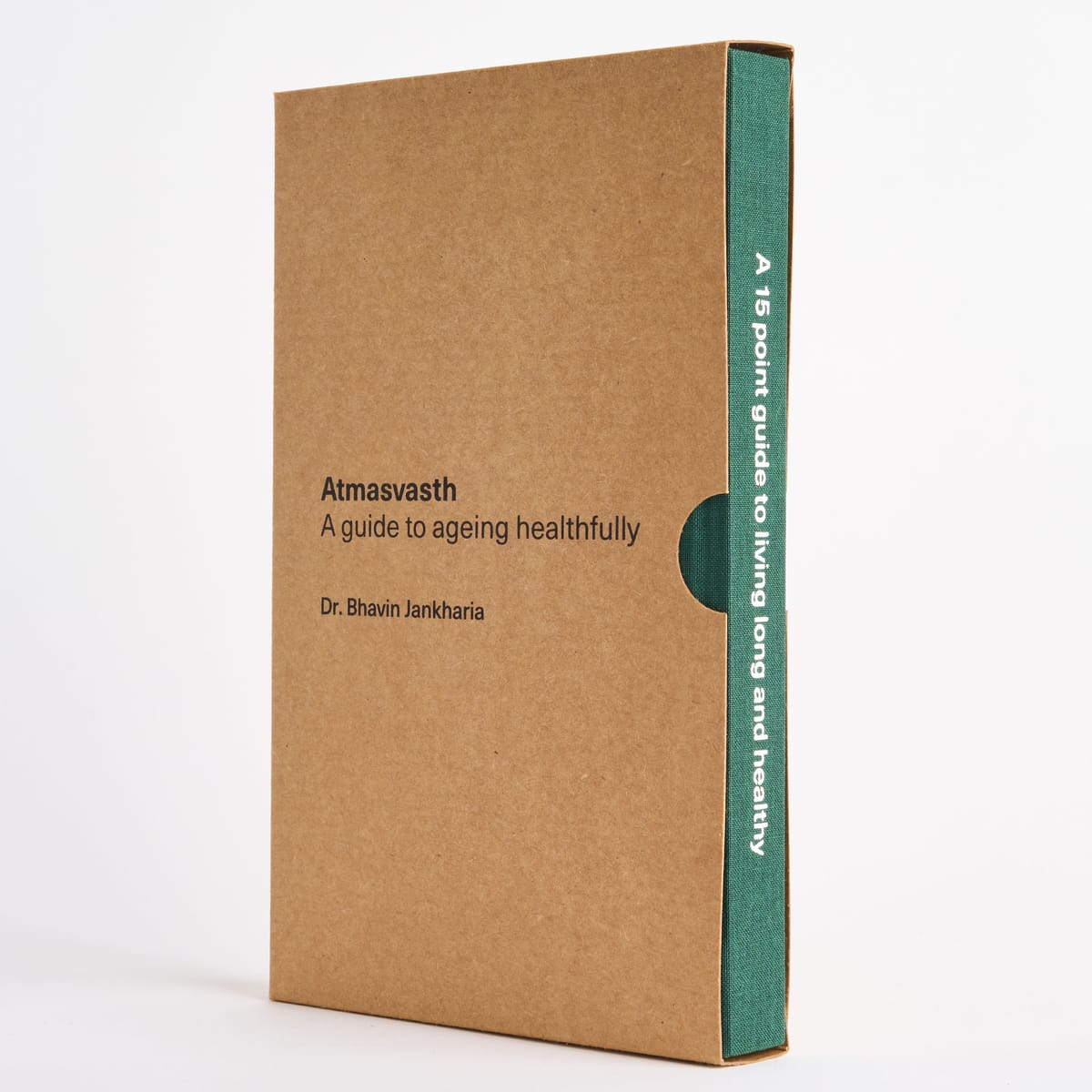
Atmasvasth Newsletter
Join the newsletter to receive the latest updates in your inbox.