Ordained to Live, Destined to Age
Even if genetics and heredity account for 50% of your lifespan, a long lifespan with misery is worse than a short lifespan well-lived.
The Book
 Bhavin Jankharia
The Detailed 15-Point Guide to Live Long, Healthy
Bhavin Jankharia
Audio
Soundcloud
YouTube
A YouTube version of the audio is also now available here.
Text
In Tron:Ares, Ares played by Jared Leto is a program that gets deleted 29 minutes after it is 3D printed into the real word as a humanoid. It craves “permanence”…to live like a human in the material world and not get deleted every 29 minutes. After his wish is granted by Flynn (Jeff Bridges himself), he fights Athena to save Eve Kim. Now human, he says at the end, “It’s funny, permanence. A wise man once told me, it should have been called ‘The Impermanence Code’. I guess that’s the thing about life. There’s nothing quite permanent about it.”
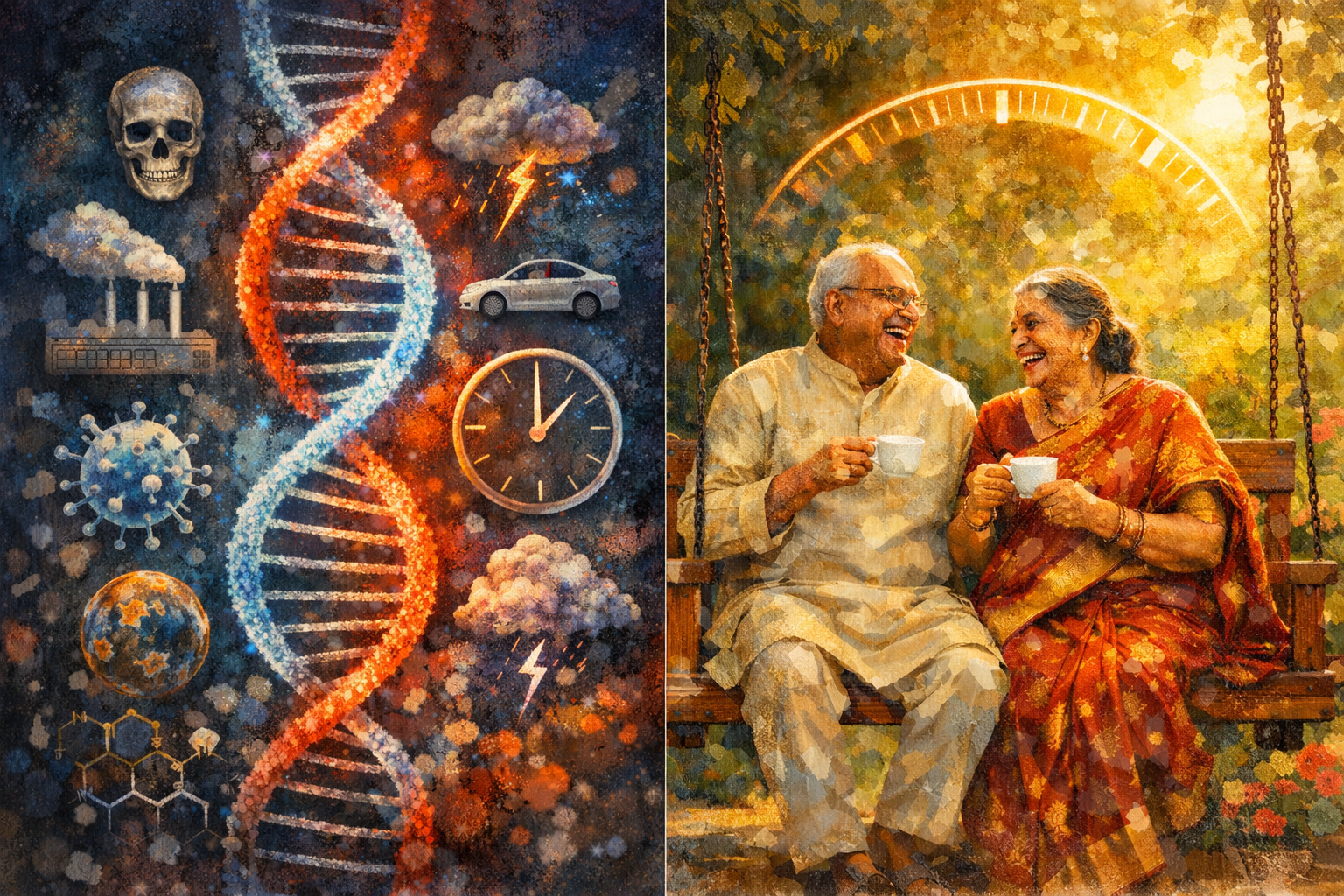
This was such a coincidence…I finished the movie just after I had written the first draft of this piece about a recent paper that has stirred up interest in longevity and lifespan with a classic click-bait headline, “Heritability of intrinsic human lifespan is about 50% when confounding factors are addressed”[1]. Using data from twin cohorts, the authors go on to say that if we account for all causes of extrinsic mortality such as accidents, infections, diseases causes by an unsuitable exposome (heat, cold, air pollution, etc), then 50% of our lifespan is genetically determined, as compared to the 10-30% that has been the accepted number till now.
Since there is “extrinsic mortality”, there is also “intrinsic mortality”, which is death that occurs due to processes arising within the body such as genetic mutations, age-related diseases and the decline of physiologic function with age [1].
When I first wrote about how much our genes control how long we live, in Oct 2023, I mentioned that heredity at best determines 10-30% of our lifespan [2] and this is also modifiable depending upon our lifestyle by up to 4.35 years [3]. What this new paper by Ben Shenhar and colleagues [1] says is that if we factor in external mortality, then genes and heredity will account for almost 50% of the reason we live up to a specific age.
And that is where the issue is. How do we know how long is the life that our genes and heredity have ordained? My paternal grandparents had lives of deprivation and poverty, and likely malnutrition in their childhood, in the late 1800s/early 1900s in the villages of Kathiawar and they lived till the age of 65 or so. However a large number of my aunts and uncles and cousins seem to be living till beyond the age of 90, unless an “extrinsic” factor cuts their lives short…a few of them have succumbed to heart attacks, strokes and cancers with very few affected by depression. My parents are doing reasonably well at 89 and 85 respectively with a few “intrinsic” factors that currently affect their healthspan and may eventually end their lifespan.
Does this mean that 90 is my heredity-determined lifespan, assuming I don’t get into an accident or get struck down by an act of God? Or is it 100, if I assume that our nutrition and disease prevention have been better than those of my parents’ generation (though the air pollution is worse, and we don’t know what balances out and how), and that maybe even they are not living to their full potential?
There is a lovely article published in Nature Aging by Felipe Sierra in Sep 2025 [4] that tries to explain why we age. Ageing is basically the accumulation of macromolecular damage, which occurs due to extrinsic and intrinsic insults but without 100% efficiency of the repair process as we become older. Why does the repair process become inefficient? This is likely a function of our evolution and the process of natural selection, which probably decreed over the last 100,000 years or more that humans are good to live till around age 60-70 and then it doesn’t really matter, which is when the resilience of the body starts dropping.
This limits how long we are going to live, irrespective of what we do, a fact also borne out by a study by Jose Andrade and colleagues [5] that shows that in high income countries that have already seen significant gains in longevity, this mortality improvement is decelerating as we hit the natural barrier to eternal life ordained by our genetics and our environment. You can’t beat death. At best, you can postpone it to whatever it is that your genes and heredity would let you live until, assuming that you have controlled for all the extrinsic factors that could have hastened death and increased your healthspan in the best way possible by being physically active, eating sensibly, sleeping well, not smoking, controlling high blood pressure, diabetes and high lipid levels and preventing those infections and cancers that can be prevented, etc.
In the end, it doesn’t really matter how much our heredity controls how long we are supposed to live because the vast majority of us seem to be on our way to living till the age of 90 as long as we take adequate measures to keep our healthspan intact. This was the title of my Apr 2024 piece, “Longevity is Inevitable: Extended Healthspan is Not and Requires Effort”. Some of us may live till 100, perhaps a miniscule number even longer, but unless we remain healthy enough in body and mind to enjoy a longer lifespan, it is all quite pointless.
What does the mean for you and me? Look around you. If your close relatives (parents, uncles, aunts) are all living long, then you can add some more years to that and assume that will be your natural lifespan. Then you have to make sure to have a decent healthspan and not become a burden to your spouse, children and society at large, suffering through that lifespan. A shortened lifespan well lived without suffering is far better than a long lifespan of misery.
Footnotes
1. Shenhar B, Pridham G, De Oliveira TL, Raz N, Yang Y, Deelen J, Hägg S, Alon U. Heritability of intrinsic human life span is about 50% when confounding factors are addressed. Science. 2026 Jan 29;391(6784):504-510. doi: 10.1126/science.adz1187. Epub 2026 Jan 29. PMID: 41610249.
2. Melzer D et al. The genetics of human ageing. Nat Rev Gen 2020;21:88.
3. Wang J et al. Healthy lifestyle in late-life, longevity genes, and life expectancy among older adults: a 20-year, population-based, prospective cohort study. Lancet Healthy Longev 2023;4: e535–43
4. Sierra F. Are we getting closer to understanding why we age? Nat Aging. 2025 Oct;5(10):1915-1916. doi: 10.1038/s43587-025-00969-0. PMID: 40935855.
5. Andrade J, Camarda CG, Pifarré I Arolas H. Cohort mortality forecasts indicate signs of deceleration in life expectancy gains. Proc Natl Acad Sci U S A. 2025 Sep 2;122(35):e2519179122. doi: 10.1073/pnas.2519179122. Epub 2025 Aug 25. PMID: 40854133; PMCID: PMC12415247.
Atmasvasth Newsletter
Join the newsletter to receive the latest updates in your inbox.