Do Not Drive or Be Driven on Indian Highways at Night
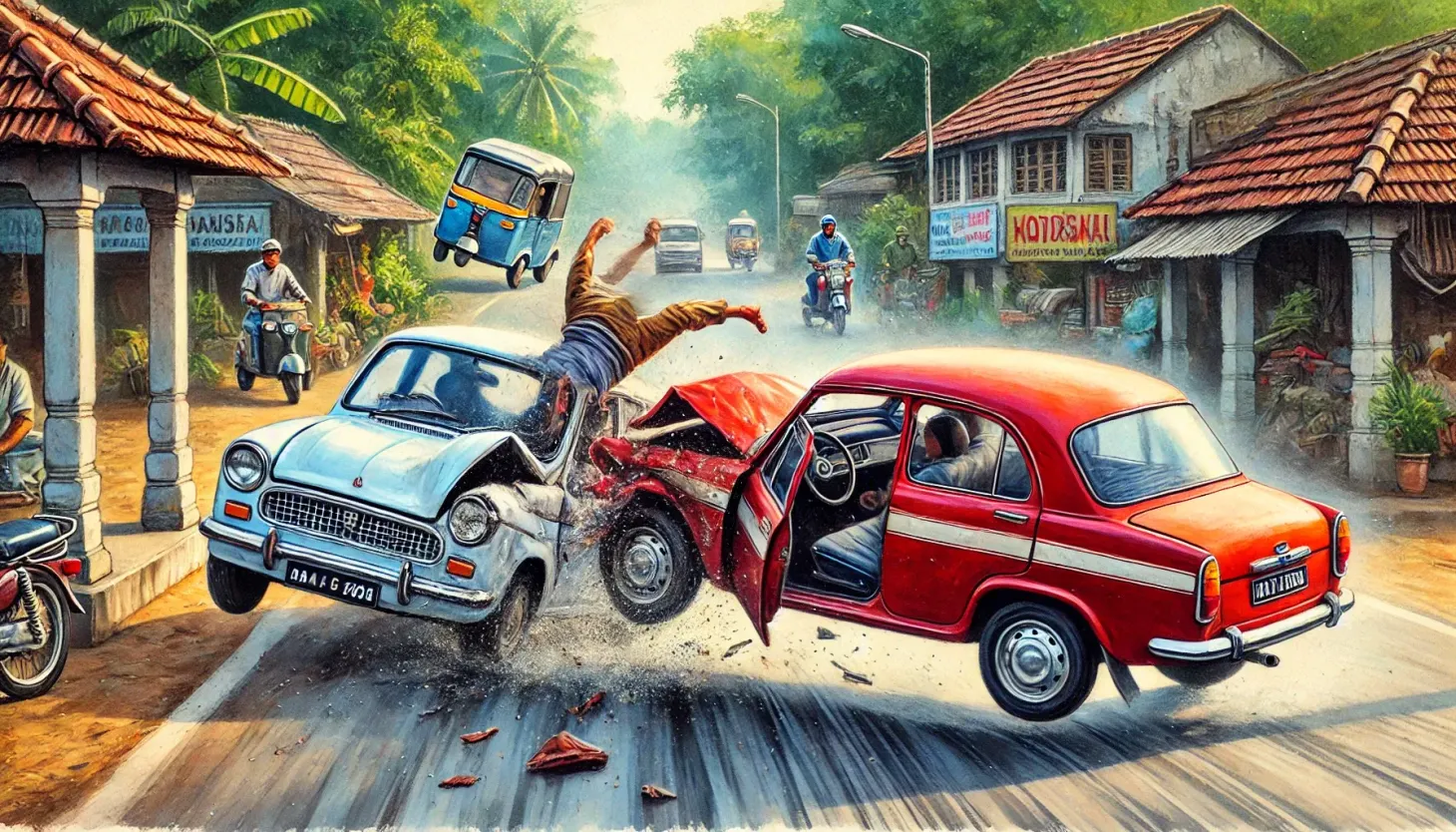
The darkness, the drunks, the wrong-side truckers, the sleep-deprived bus drivers — night driving on Indian roads is the closest thing to a preventable cause of death hiding in plain sight.
The Book
 Bhavin Jankharia
The Detailed 15-Point Guide to Live Long, Healthy
 Bhavin Jankharia
Audio
Audio File
YouTube
A YouTube version of the audio is also now available here.
Text
A few years ago, good friends of mine from the US wanted to travel to Hubli from Mumbai. They wanted to optimize their time and decided to take a sleeper bus at night. I entreated them not to travel, as did their relatives, but in their late 50s, full of bravado and false confidence, they went ahead with the trip. Nothing happened and they reached safely…but that is a trip I would have never made.
Last week, a cousin had come over and was discussing her multiple Jain jatras across the country. One was to Samvetshikar now in Jharkhand and I asked if it had gone well. She told me this harrowing story of how their bus broke down at night after which there were local goondas on bikes who kept circling their bus and how all of them managed to walk together in a tight square to a nearby hotel to spend the night in, sheltering the young girls in the middle. Apparently, the young kids (in their 20s and 30s) work and wanted to optimize their jatra time by traveling at night.
The 9th point in the 15-point Atmasvasth guide is
9. Address abnormal environmental exposures (your exposome) and stressors at a personal level (air pollution, noise pollution, extremes of temperature, digital noise, accidents - intended and unintended, management of incidental findings when asymptomatic) - daily, one time
The 7th subpoint is
- Avoid being in road accidents at all costs. In India, riding a two-wheeler is the most common cause of a fatal road accident, followed by being a pedestrian. Use safe practices to avoid being in a road accident and to mitigate the risk of injury and death, if you do get into one, e.g. wear a seatbelt at all times, even if you are in the backseat being driven.
I've written about road accidents twice already — in Nov 2023 and in Aug 2025 and in both I wrote
Do not be driven at night outside of busy city roads. As tourists or for work, we often think it is a good idea to travel at night and save time. Bus drivers drink and/or fall asleep. Taxi drivers are also often sleepy. All this increases the risk of accidents and death.
I cannot stress this enough.
Just How Big is This Risk?
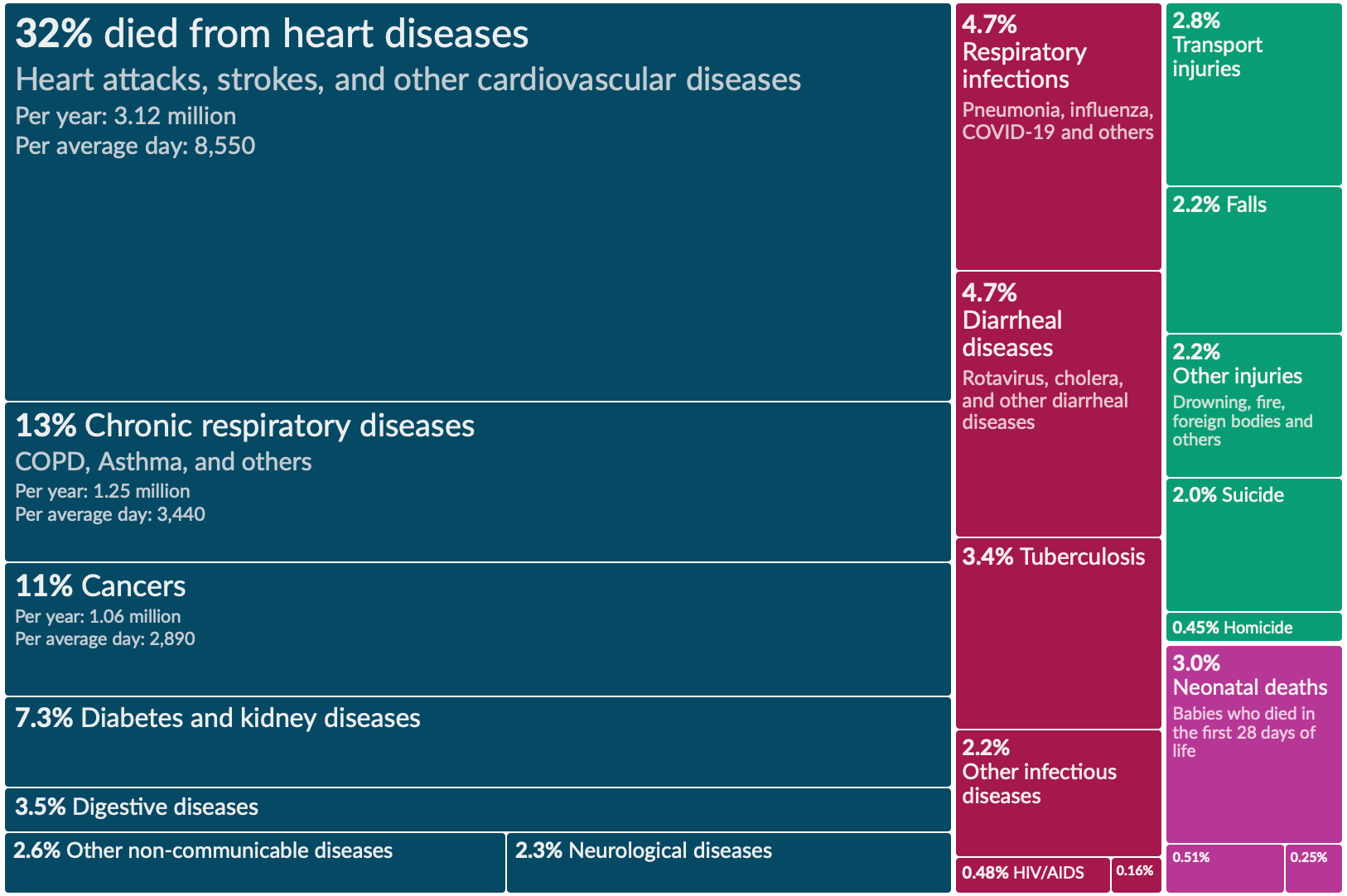
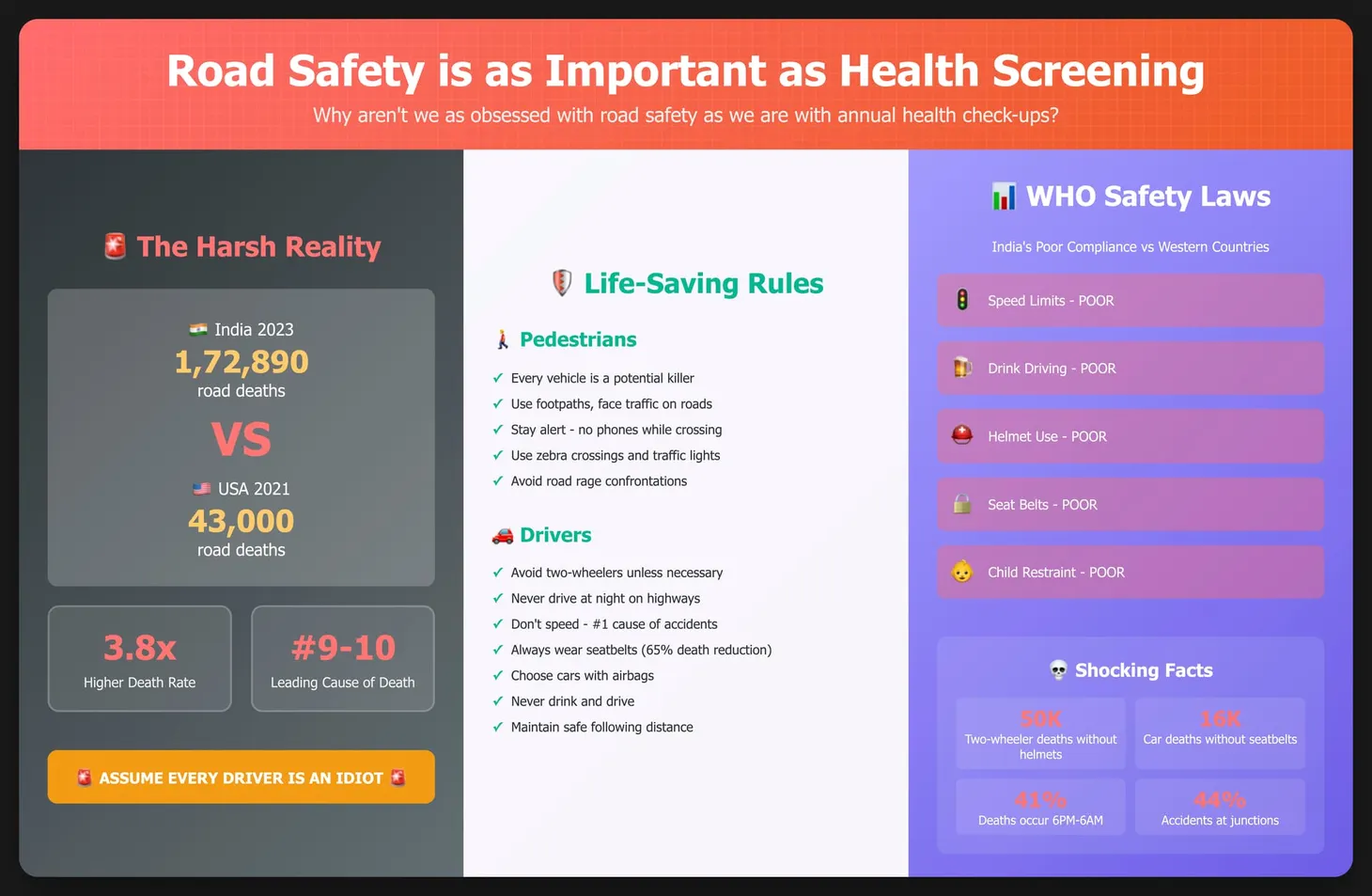
Take a look at the IHME treemap of how Indians died in 2023. Transport injuries (the large majority of which are road accidents) accounted for 2.8% of all deaths in India — roughly 2.7 lakh deaths a year when you use the SRS-based estimate, or 1.73 lakh using the Ministry of Road Transport and Highways (MoRTH) police-reported numbers for 2023 [1]. Either way, road accidents are the 9th or 10th biggest killer in the country, ahead of falls, suicide, HIV, and any single individual cancer.
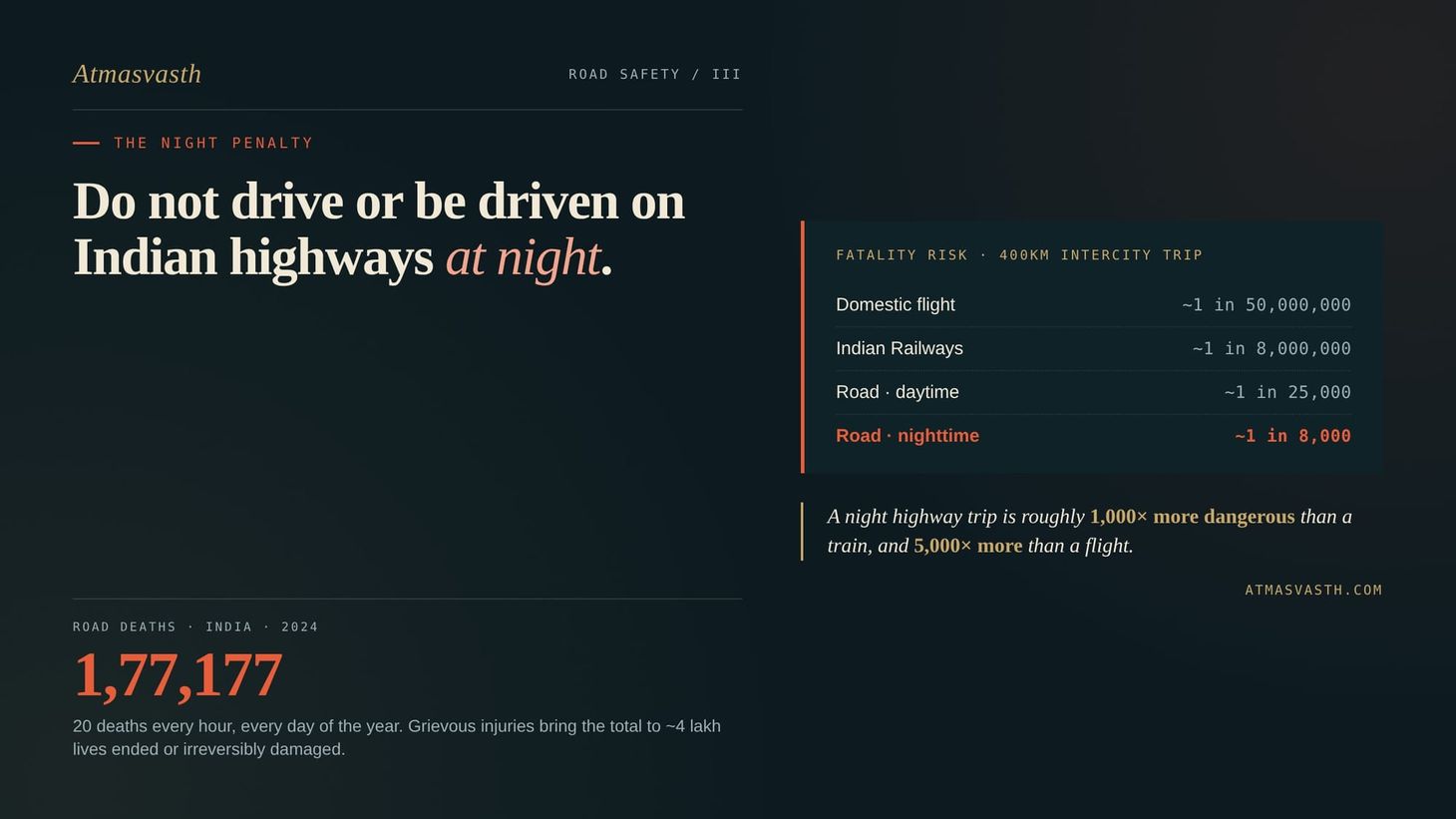
To put 2023's 1,72,890 deaths in perspective — it comes to 55 accidents and 20 deaths every single hour, 24 hours a day, 365 days a year. The provisional 2024 numbers from a Rajya Sabha answer last year [2] are worse still — 4,87,705 accidents and 1,77,177 deaths. We continue to add roughly 5,000 to the annual death toll each year.
And fatalities are only half the story. In 2023, alongside the 1.73 lakh deaths, there were 1,58,576 grievous injury accidents — crashes serious enough to require hospitalization [1]. If you add fatalities and grievous injuries together, the annual count of catastrophic outcomes on Indian roads is closer to 4 lakh per year.
Is the Risk Really That Bad on a Night Highway Trip?
Let me try to put a number on it, because "be careful, it's dangerous" is not useful without a sense of scale.
The best way to compare transport modes is deaths per passenger-kilometre. These numbers are rough — and the Indian data is especially rough — but the orders of magnitude are robust. Per one billion passenger-kilometres travelled, you get approximately:
- Commercial domestic flight in India: ~0.05 deaths. Indian scheduled commercial aviation reported zero accidents per million departures in 2023 per ICAO [3]. A crash is possible but extremely rare.
- Indian Railways passenger journey: ~0.3 deaths. Indian Railways moves roughly 23 million passengers a day. In FY 2023-24, there were 313 passenger deaths across all train accidents — less than one-in-a-million per journey [4].
- Indian highway travel by car or bus: roughly 100–120 deaths. This is 400 to 4,000 times higher per kilometre than rail, and 2,000 to 20,000 times higher than air.
Translate this into what it means for a single 400-km intercity trip — Mumbai to Pune and onwards, say, or Bangalore to Mysore and beyond — and the per-person fatality risks look roughly like this:
| Mode | Approximate fatality risk per 400km trip |
|---|---|
| Domestic flight | ~1 in 50 million |
| Train | ~1 in 8 million |
| Intercity car/bus during daytime | ~1 in 20,000 to 1 in 25,000 |
| Intercity car/bus at night | ~1 in 8,000 to 1 in 10,000 |
Add grievous injury to the calculation and the night-trip number becomes closer to 1 in 3,000 per person per trip. Let me explain this better. If you and your family of four take ten such night trips a year, over a working lifetime of thirty years, that is 1,200 person-trips and a lifetime probability of a catastrophic outcome of around 30%. One in three. Think of any three families you know that routinely travel overnight by bus or taxi for work, pilgrimages, or family weddings — the math predicts that one of those three families will eventually have a member killed or grievously injured.
Compare that to the lifetime cumulative risk of the same family taking 1,200 domestic flights instead — somewhere around 1 in 40,000. The difference is not marginal. It is the difference between a risk you should lose sleep over and a risk you can safely ignore.
And this is before you add the second-order risks that my cousin's jatra group ran into — breakdown in an unsafe area at night, goondas circling the bus, nowhere to go, young women to shelter. These things never make it into any ministry's accident tables.
What Actually Kills You at Night
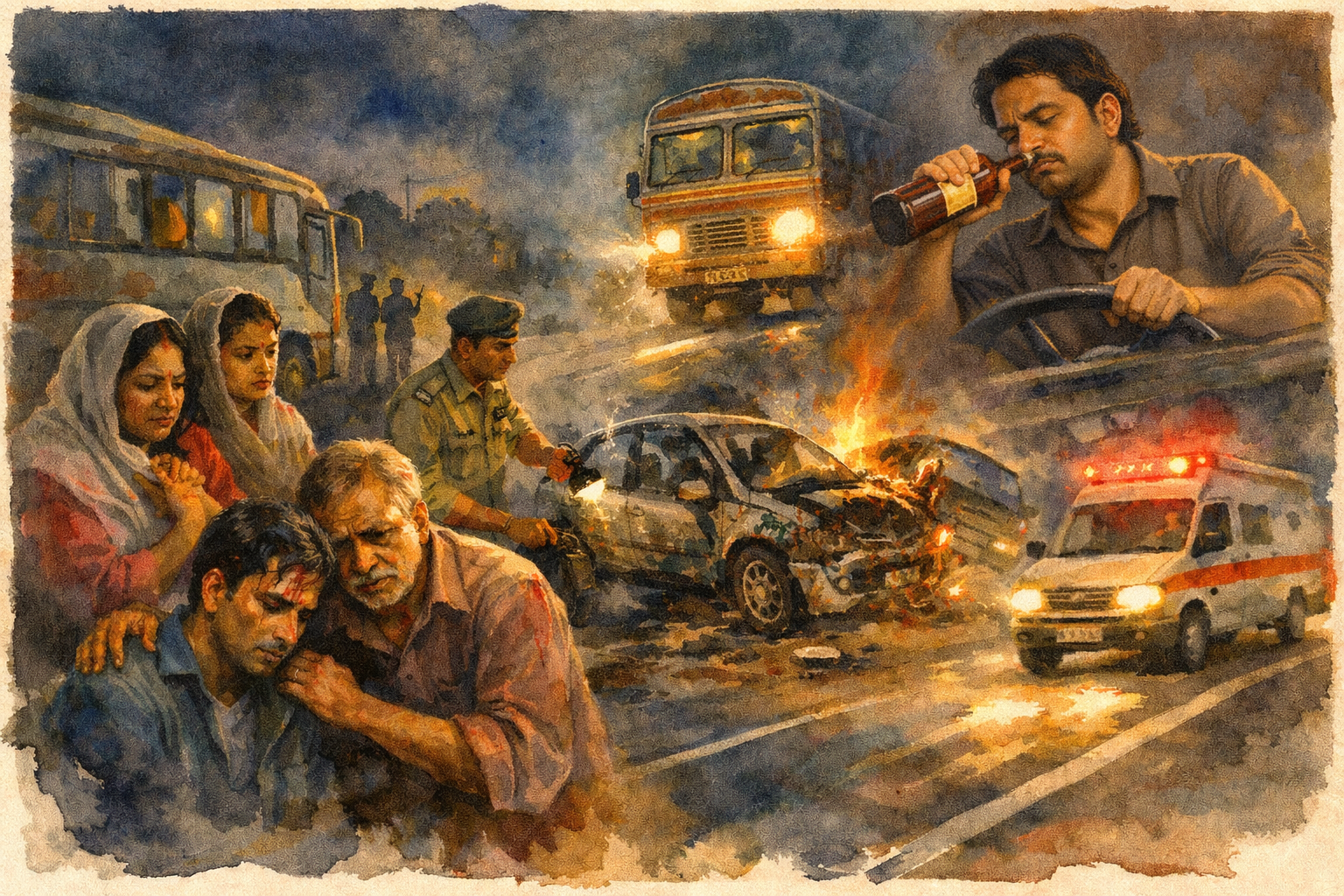
Let me unpack the specific hazards that stack on top of each other after dark. Each one, on its own, is bad. Together, they are lethal.
1. Darkness itself. Indian highways are poorly lit or unlit entirely. Lane markings fade. Reflective signage is patchy. Cyclists, pedestrians, stray cattle, stalled trucks with no hazard lights, tractors with no tail-lights — all of them become invisible until you are on top of them. Your stopping distance at 80 kmph is about 55 metres. Your effective high-beam range on a good night is maybe 100 metres. Subtract the two seconds it takes to register a hazard and react, and there is almost no margin. Your eyes also get worse at night as you age — a 60-year-old needs roughly 3 times more light than a 20-year-old to see the same thing.
2. Drunk driving — the official number likely underestimates the true incidence. The 2023 report says drunk driving caused only 2.1% of accidents and 2.1% of deaths [1]. This is absurd, and everyone who has driven in India knows this. Reports list only one "primary cause" per accident, and that cause is almost always over-speeding (68.1% of deaths in 2023). A drunk driver who crashed at high speed gets counted under over-speeding. A blood alcohol test is rarely done on dead drivers, and hardly ever on survivors.
Who drives drunk? Evening and night drivers. Truck drivers between cities after a chai-and-rum stop. Car drivers coming home from weddings, parties, bars, weekend farmhouses. Bus drivers on long-haul overnight routes. The night shift on Indian roads has a blood alcohol problem that the official statistics refuse to acknowledge.
3. Wrong-side driving. The 2023 report puts this at 5.5% of deaths — 9,432 people killed in one year by someone driving on the wrong side of the road [1]. On any national highway at night, wrong-side driving is not an occasional hazard — it is a constant one. Truckers take the shorter wrong-side stretch to avoid a kilometre-long U-turn. Two-wheelers use the wrong side as a shortcut. Cars do it because the divider cut is "too far". At night, you cannot see a wrong-side driver coming until his headlights are blinding you and the geometry has already become unsurvivable.
4. Fatigue — the cause nobody counts. There is no column in the Indian accident-reporting format for "driver was asleep" or "driver had been on duty for 16 hours." The international evidence is very clear: driving after 17 hours without sleep impairs you as much as a blood alcohol level of 0.05%, which is the Indian legal limit for being drunk [5]. After 24 hours awake, the impairment is equivalent to 0.10% — legally drunk in most countries. Bus drivers doing Mumbai to Goa, Bangalore to Hyderabad, or Delhi to Jaipur overnight are routinely on duty for 14-18 hours. Truck drivers routinely drive for 16-20 hours with brief breaks. This fatigue layer gets hidden inside "over-speeding" and "hit from back" in the official numbers, but it is a massive contributor, particularly in the 2 AM to 5 AM block when the body's circadian low is at its deepest.
5. Post-crash care collapses at night. Even if you survive the crash, your odds of surviving the next 60 minutes — the so-called golden hour — are much worse at night. Ambulances are fewer. Smaller highway hospitals are under-staffed after 10 PM. Trauma surgeons are not on site in most Tier 2 and Tier 3 towns between midnight and 8 AM. The Ministry's 2023 data confirms that 68.5% of road deaths occur in rural areas [1], where medical infrastructure is already limited. A crash on NH-48 at 2 AM gets you a qualitatively worse medical response than the same crash at 2 PM.
6. And everything else. My cousin's goondas-circling-the-bus story is the other reason to avoid overnight highway travel that gets left out of safety discussions. Vehicle breakdowns, medical emergencies, fuel shortages, getting lost — all of these are annoying inconveniences during the day, and genuinely dangerous situations at night. Cellphone signal is patchy on many highways. Roadside help is slow. And the shoulder of an Indian highway at 2 AM is not a place you want to be standing on, with your family.
So Why Does Everyone Keep Doing It?
Because the savings look real. An overnight bus to Goa saves you a working day. A 10 PM drive to the Lonavala farmhouse feels efficient because "the traffic is less." A red-eye to Mumbai from Pune gets you to an early meeting. The young jatra-going kids in my cousin's group wanted to "optimize" their pilgrimage time. My American friends wanted to "optimize" their Hubli trip.
The cost of the saved time is borne in a statistically small but personally catastrophic probability of injury or death. Most of us make these journies hundreds of times without incident and conclude that the risk is imaginary. It is not. It is just infrequent. And when it does happen, the outcome is irreversible — a dead child, a paralysed spouse, a traumatic brain injury (TBI) that ends a career.
What to Do Instead
- Treat "night driving on highways" as a binary choice and default to no. Not "I'll try to avoid it." Not "unless I'm in a hurry." Simply, no. Plan your travel so that you are off the highway by sunset and not back on it until after dawn.
- If you must travel overnight, take a train or fly. Indian Railways is not glamorous, but it is by an enormous margin the safest way to cover long distances overnight. Flights are safer still. The incremental cost of a flight over an overnight bus or taxi is almost always worth it when you price in the fatality and grievous injury risk.
- If you absolutely must be in a car at night, be the driver. You can at least control your own alertness, sobriety, and speed. You cannot control a bus driver who has been awake for 18 hours or a taxi driver whose shift started at 6 AM the previous day. If you do drive yourself, do not drink at all that evening, drive under the speed limit, use full lights defensively, and take a break every 90 minutes. And accept that you will arrive tired and sleep the next day.
- Never let someone drive you at night if you cannot personally vouch for their sobriety and rest. This includes the bus company's driver and the taxi driver from the app. You have no way to know whether they slept four hours or fourteen. The kindest assumption you can make about an overnight commercial driver in India is that they are tired. The realistic one is that they may also have had a drink.
- Refuse invitations and arrangements that require night driving outside cities. This is uncomfortable because it feels rude. It is not rude. It is sensible. If a wedding ends at 11 PM two hours away on a highway, do not drive back. Stay over. If a meeting in the next city requires you to leave at 4 AM, take the 7 AM flight instead. If a family jatra involves a 2 AM bus from Mumbai to Jharkhand, pay more and fly to Ranchi and drive the last leg by day. The incremental cost is trivial; the avoided risk is enormous.
- Within cities, night driving is usually fine. I am not saying lock yourself indoors after dark. Driving home in Mumbai at 10 PM from a friend's place in Bandra is not remotely the same problem as driving on NH-48 at 10 PM. City roads are lit, speeds are lower, other vehicles are visible, and medical help is minutes away. This rule is specific to highways and inter-city travel.
What Does this Mean for You and Me?
You can eat perfectly, run your Zone 2 every morning, get eight hours of sleep, take every vaccine on schedule, keep your LDL at 70, not smoke and still be wiped out in a single instant by a drunk truck driver on the wrong side of the expressway at 11 PM.
We spend enormous amounts of time and money to increase our healthspan and lifespan by a few percentage points each. The probability of dying or being grievously injured on an Indian highway at night is not a few percentage points; it is one of the largest preventable risks with a simple intervention.
Stop being on Indian highways after dark.
Footnotes
1. Road Accidents in India 2023. Ministry of Road Transport and Highways, Government of India. http://morth.gov.in/backend/documents/uploaded/Road-Accident-in-India-2023-Publications.pdf
2. Rajya Sabha Unstarred Question No. 1227, answered 10 December 2025. Minister of Road Transport and Highways. State-wise details of accidents and fatalities for 2020-2024.
3. ICAO Safety Report, cited in Statista's India aviation safety series. Indian scheduled commercial aviation reported zero accidents per million departures in 2023.
4. Ministry of Railways (India), as reported in the press; 313 passenger fatalities across 40 train accidents in FY 2023-24.
5. Williamson AM, Feyer AM. Moderate sleep deprivation produces impairment in cognitive and motor performance equivalent to legally prescribed levels of alcohol intoxication. Occup Environ Med. 2000 Oct;57(10):649-55. https://pmc.ncbi.nlm.nih.gov/articles/PMC1739867/
Atmasvasth Newsletter
Join the newsletter to receive the latest updates in your inbox.