Pranayama, Like Yoga and Meditation...Perhaps a Good Feeling, but Expect Nothing More
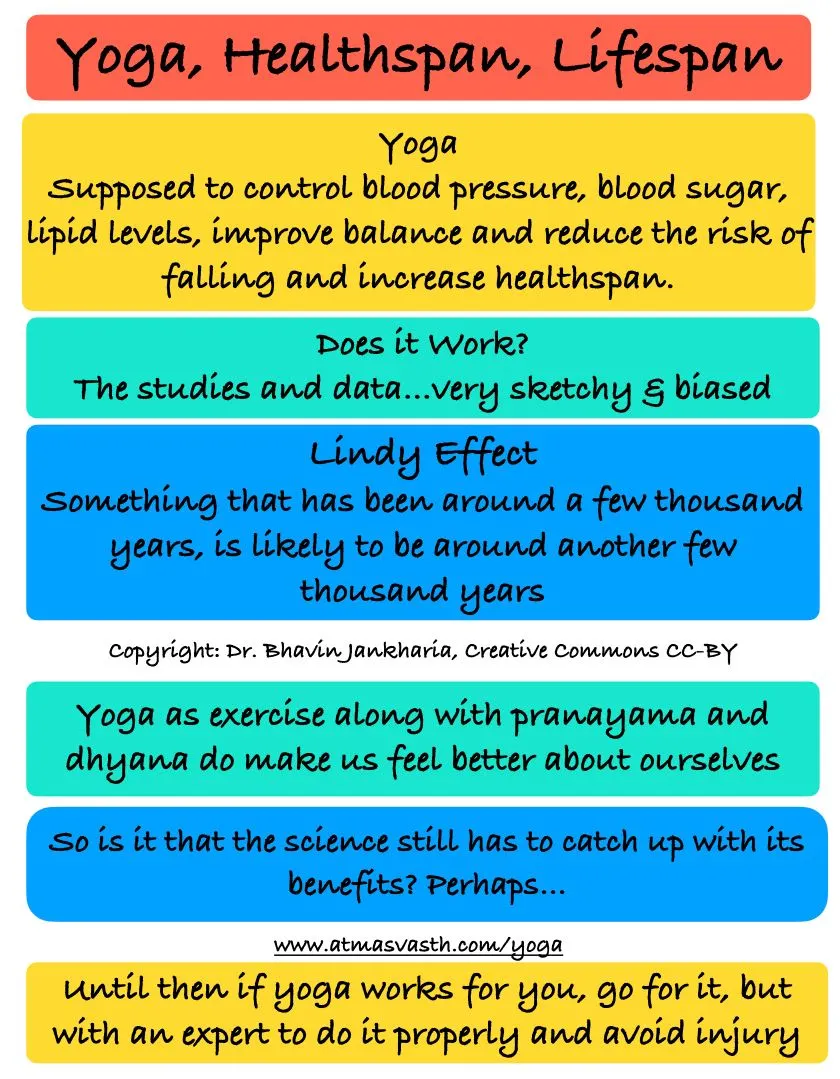
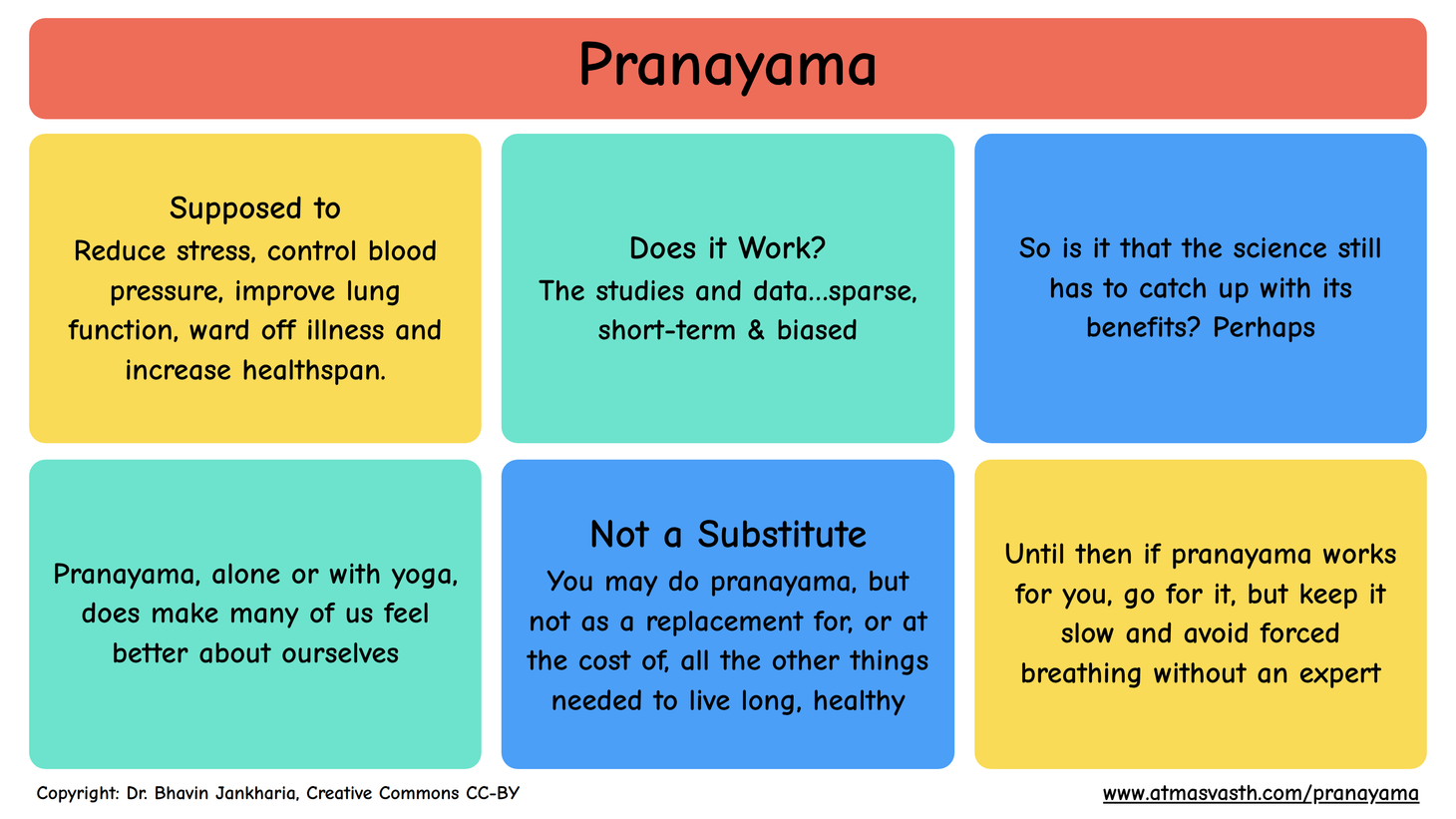
Pranayama, like yoga and meditation has no evidence base to suggest it does anything beyond making you feel good about yourself
Audio and YouTube versions available at the end of this email.
A couple of weeks ago, Ajit emailed me asking why I hadn’t and wasn’t writing about the benefits of pranayama.
I told him that Atmasvasth is about actionable items and information that allow us to live long, healthy and improve our healthspan and lifespan and to my knowledge there was no data that pranayama helps us do that. I asked him to come back with evidence to the contrary and to his credit, he spent a good week checking multiple sources with the help of 2 or 3 different LLMs and came up with a document that in the end said that while there is no evidence that pranayama improves healthspan and lifespan, there is some sparse evidence, from trials that are themselves not of good quality [1], that it helps control high blood pressure, along with physical activity, sensible eating, adequate sleep and medicines.
For those who are unaware, pranayama, either standalone or performed with yoga is a set of breathing exercises of different forms involving both normal breathing and forced breathing.
The absence of evidence is not evidence of absence of its effectiveness, is what pranayama believers will say and in most instances where similar talk of yoga and meditation comes up, it is almost impossible to have a sane, logical argument, because believers will use everything they can…from saying that it is part of our “sanskriti”, or that there is evidence in the Vedas and other ancient books that it works or that modern medicine has just not caught up with the evidence that is so obvious…to them…because it works for them and has worked for people around them.
However, when you go through all the studies published so far, absence of evidence does look like evidence of absence. It is not that people haven’t tried to study pranayama, yoga and meditation. There are hundreds of trials, but most of them are short term and typically focus on how a person feels at the end of 8-12 weeks…there is no data that shows how they hold up to prevent illness and disease.
Let’s revisit yoga for a bit.
Physical activity is the cornerstone of the 15 points to live long, healthy and yoga does work as a form of physical activity, but there is no evidence it does anything beyond that. While Tai-chi has been proven to improve balance and to prevent falls [2], there is really no good evidence that yoga does even that, though it makes intuitive sense that if you can hold a tree pose for 1 minute, your balance will be good…though it could just be that because you have good balance you can hold the tree pose and not the other way around.
In 2022, I mentioned the SAGE trial whose results had not yet been published. This study was finally published in 2025 [3] and unexpectedly there were more falls in the yoga group, with no difference in the injurious falls rate between the yoga and non-yoga groups. The reason proposed was that yoga probably increases balance confidence but without an increase in actual balance capacity. Feeling steadier is not the same as being steadier.
Meditation too, may help with clearing your mind, making you a calmer individual and perhaps giving you some direction in life, but there is no evidence it helps us with a better healthspan.
The same is therefore true of pranayama. If you believe in it and it hopefully does not cause you harm, then that’s fine with the caveat that forced breathing exercises do have the potential to injure [4]. But to think that daily pranayama will ward off illness and keep away disease is perhaps stretching things a bit too far, unless we can find some better evidence to support this assumption.
The danger with believing that pranayama, yoga and meditation are a panacea is the same danger that comes with taking multivitamin and mineral supplements every day…a false sense of security that can make you ignore all the other issues necessary to prevent disease or to catch it early and treat it. For example, if you have high blood pressure of 150/100 and believe that yoga and pranayama and meditation can control it, and even if the blood pressure never goes below 145/95, you refuse to take medications, then you are ignoring basic preventive healthcare tenets.
Any claim must meet some basic standards of evidence. We live in a world where modern medicine is now the de facto medicine practiced everywhere. If you are going to use techniques that are considered traditional or alternative, you have to be intellectually honest and prove or find evidence they work with high quality trials and not just base your assumptions on anecdotes.
Until then, if pranayama and yoga and meditation work for you without harm, go for it. But practice them, along with all the other 15 points needed to live long healthy, not instead of.
Listening Options
Audio File
YouTube
Footnotes
- Garg P, Mendiratta A, Banga A, et al. Effect of breathing exercises on blood pressure and heart rate: A systematic review and meta-analysis. Int J Cardiol Cardiovasc Risk Prev. 2023;20:200232. (The authors' own conclusion ends: "The studies are not deprived of bias.")
- Pillay J, Gaudet LA, Saba S, et al. Falls prevention interventions for community-dwelling older adults: systematic review and meta-analysis of benefits, harms, and patient values and preferences. Syst Rev. 2024;13(1):289.
- Oliveira JS, Sherrington C, Lord SR, et al. The effect of an Iyengar yoga-based exercise programme versus a seated yoga relaxation programme on falls in people aged 60 years and older (SAGE): a pragmatic, two-arm, parallel randomised controlled trial. Lancet Healthy Longev. 2025;6(9):100749.
- Mütze C, Mitzinger D, Haller H. Effectiveness of pranayama for mental disorders: a systematic review and meta-analysis of randomized controlled trials. Front Psychiatry. 2025;16:1616996. (Adverse events were more frequent with fast than with slow breathing techniques.) See also Johnson DB, Tierney MJ, Sadighi PJ. Kapalabhati pranayama: breath of fire or cause of pneumothorax? A case report. Chest. 2004;125(5):1951-2.
 JPLLP
JPLLP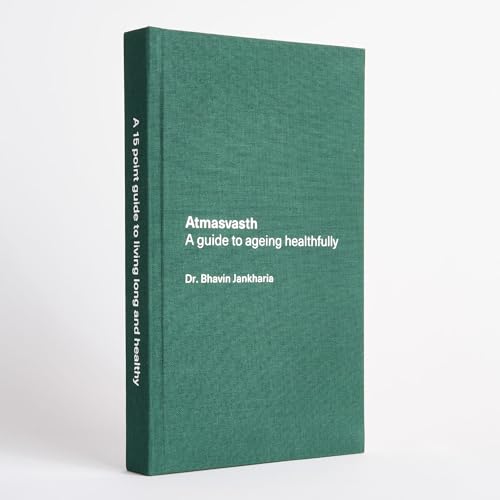
 JPLLP
JPLLP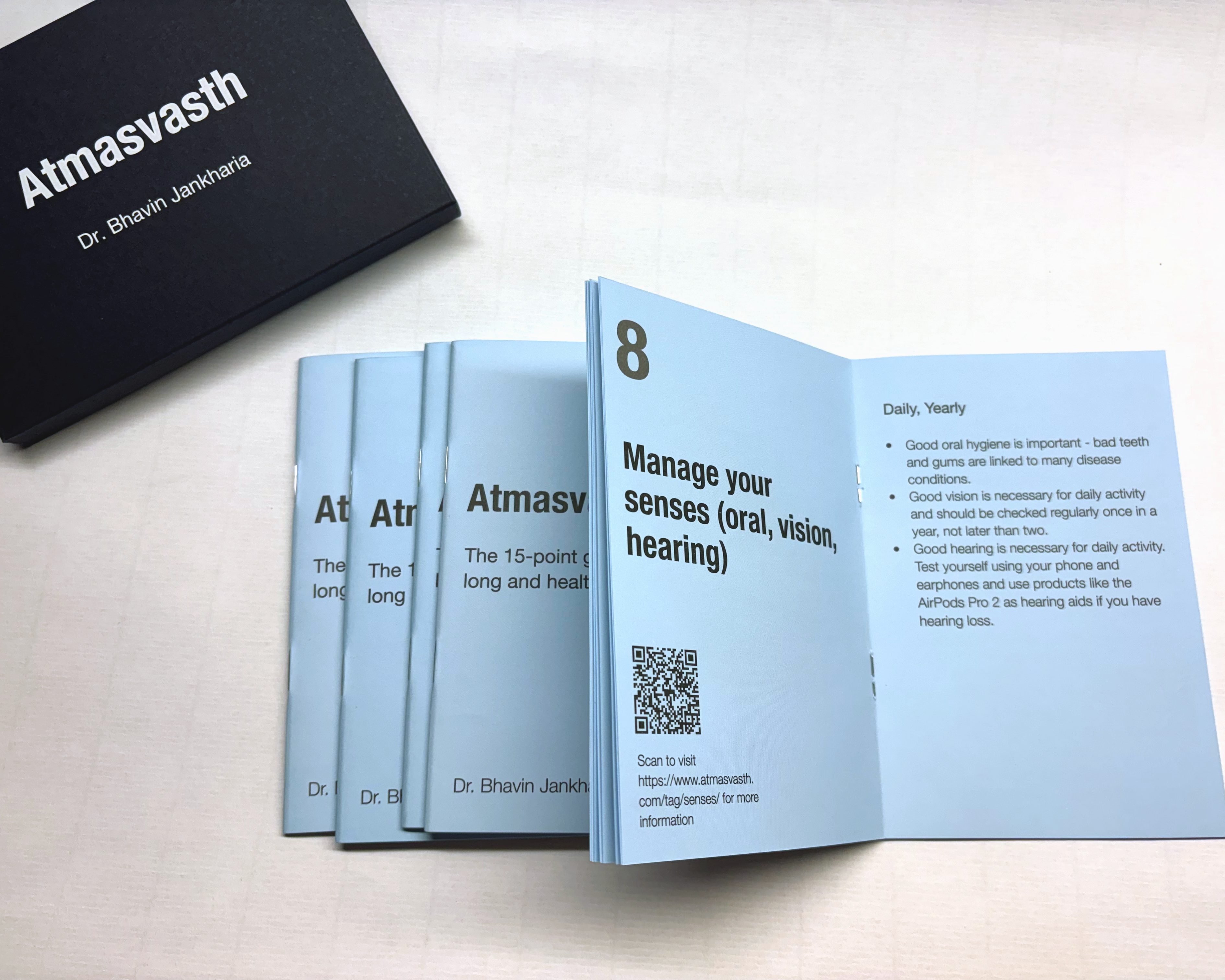
The Detailed 15-Point Guide to Live Long, Healthy
 Bhavin Jankharia
Atmasvasth Newsletter
Join the newsletter to receive the latest updates in your inbox.