What Your Watch Can Save You From
Finally, one condition where a smartwatch makes a difference with timely diagnosis
Audio and YouTube versions available at the end of this email.
It's a simple question. Does wearing tech, either in the form of a smartwatch like the Apple Watch or a ring like Ouro or Ultrahuman help you live long, healthy. The watches and rings make a lot of claims, but in the end, do they make a difference beyond just being fancy fitness trackers and spewing out unactionable data?
Wearable tech's promises have ranged from heart attack diagnosis to detection of atrial fibrillation, falls, blood pressure, sleep changes, SpO2 drops and the like. Most of these indications are still works-in-progress, promises and hopes rather than reality…
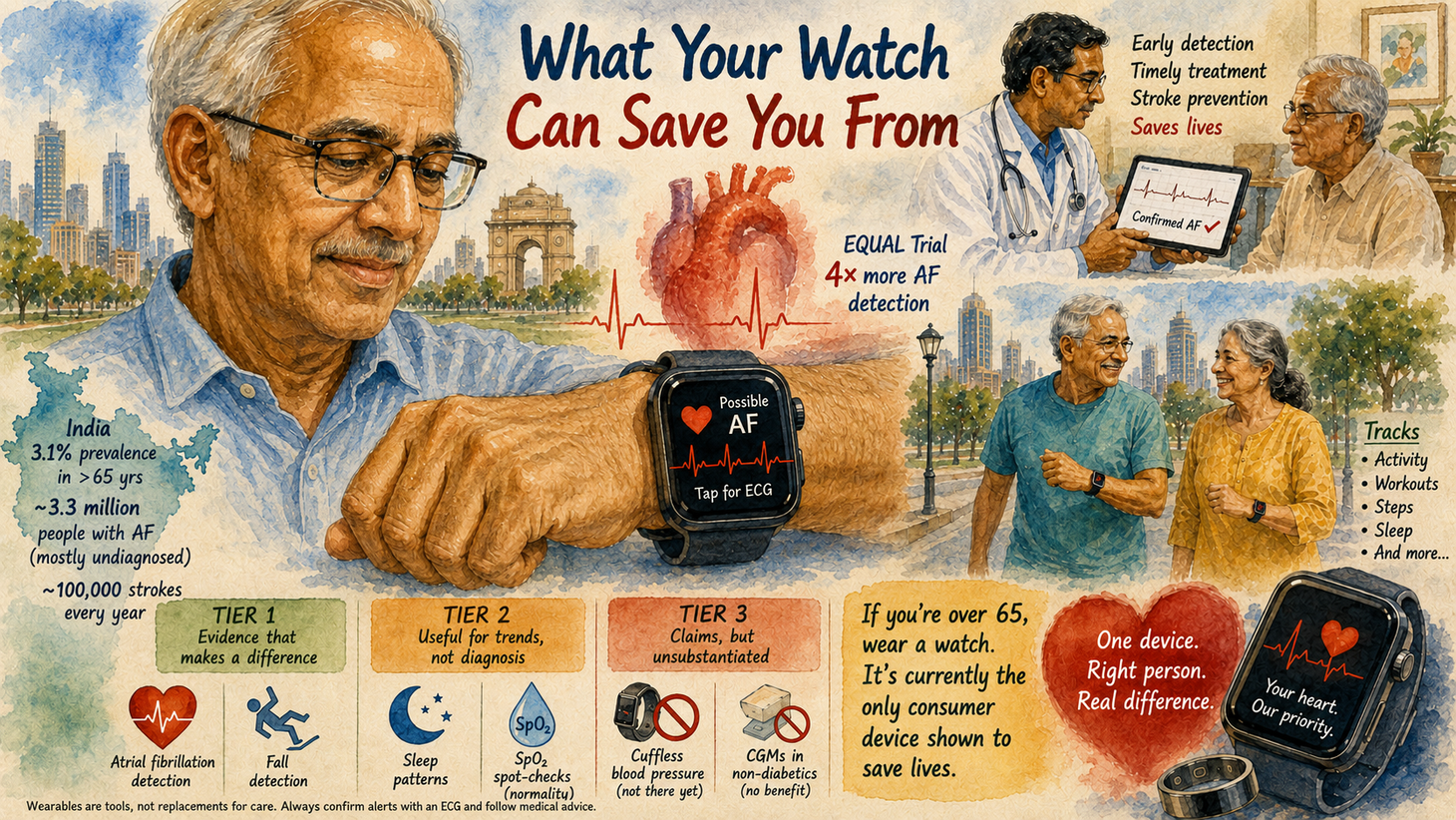
…until a month or so ago, when the results of the EQUAL trial [1] were published in JACC. This study headed by Nicole van Steijn and colleagues was a randomised controlled trial across two Dutch secondary-care cardiology centres. 437 patients aged 65 or older, with elevated stroke risk (CHA₂DS₂-VASc ≥2 in men, ≥3 in women) and no prior diagnosis of atrial fibrillation, were randomised to either six months of Apple Watch monitoring or standard care.
What is atrial fibrillation (AF)? I wrote about this first in Aug 2021.
 Bhavin Jankharia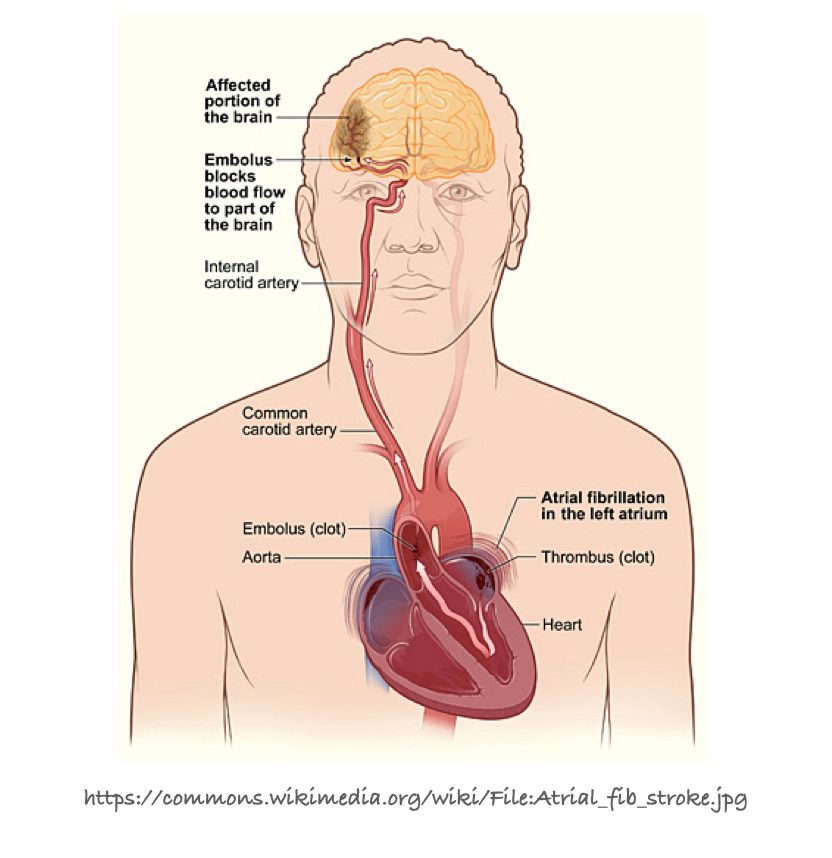
Atrial fibrillation or Afib or AF for short is a condition where the atria of the heart (the upper two smaller heart chambers) beat irregularly. This leads to a "quivering" of the heart and a disordered rhythm (also called arrhythmia). Apart from symptoms of palpitations and light-headedness, which are not that common (most patients with AF have no symptoms), the major challenge is that of the potential complications of AF, mainly stroke.
It can be diagnosed by ECG and hence the recommendation for yearly ECG after the age of 65 years. If AF is found, then anticoagulation with blood thinner medication reduces the risk of stroke and saves lives.
It stands to reason that if AF can be diagnosed when it happens, not just at the time of a yearly health check-up, it would pick up more cases that would benefit from early treatment. EQUAL did just that. The study diagnosed new-onset AF in 9.6% (21 patients) of the smartwatch group and 2.3% of the control group. 14 patients screened led to one diagnosis of AF. Twelve of the 21 AF cases in the smartwatch arm (57%) were completely asymptomatic. All 21 were started on anticoagulation.
Now 54% of the alerts were false alarms, which is fine, because all you need to do is to get one ECG done immediately after the alarm to confirm or rule it out. As long as the smartwatch has high sensitivity and does not miss any AF, which is the role of a screening tool and the harm from a false positive is minimal (one ECG to be done, as against say a biopsy with a false positive nodule pickup on mammogram), it is doing its job.
EQUAL matters not because it is the first study to suggest wearables can detect AF — there have been many — but because it is the first to demonstrate, in a randomised trial, that a fully consumer-grade device (a watch already worn by tens of millions of people) embedded in an organised clinical workflow produces a four-fold increase in the detection of a condition that kills people via stroke.
We don't have current statistics for the prevalence of AF in India, but the reference I quoted [2] found a 3.1% prevalence in Indians over 65 years of age. With approximately, 7.4% of India's population of 1.46 billion today being over 65 years of age [3] (10.8 crores or 108 million), that works out to a prevalence of 33.5 lakhs (3.35 million), most of them undiagnosed. At a stroke rate of around 3% annual [4], that means approximately 100,000 strokes per year. We don't have the resources to either screen all these people or to prevent strokes if we diagnose them or to manage these strokes in time.
Bhavin Jankharia
Even if just 1-2.5% of the 10.8 crores can afford an Apple smartwatch (and an iPhone), that would mean around 11-27 lakhs wearing an AF detecting device that could potentially detect 33,500-84,000 AFs and prevent 650-1650 strokes per year. This is a big deal, though the actual numbers will be lower because affordability does not guarantee adoption — older adults consistently lag younger users in wearable ownership and use [5], and EQUAL itself recorded patients who declined the watch out of anxiety about being monitored or because of family concerns about electronic devices [1]. The hesitance is greatest in those over 75-80, who are typically the hardest to convince that a small device on the wrist is worth wearing every day [6] — and who, paradoxically, have the most to gain from it.
So where are we with wearable tech today and what else can it do apart from triggering AF.
Tier 1: Where there is some evidence that they make a difference
- Atrial fibrillation diagnosis. This is what EQUAL has shown.
- Fall detection. Validation studies show smartwatch fall-detection sensitivities of 77–90% with high specificity [7]. The problem is that this is an after-the-fact issue, i.e the smartwatch does not prevent the fall, but allows someone to realize that a person has fallen and to take quick action, for e.g. getting the patient to a hospital and if there is a hip fracture, hoping that the person gets operated in under 48 hours, which happens rarely if at all, in our country.
Tier 2: Useful for trends, not diagnosis
- Sleep duration and pattern - accuracy is still not good
- SpO2 spot-checks, but only for normality. Below 92% they become unreliable [8]
Tier 3: Claims, especially in the popular media, but unsubstantiated
- Cuffless blood pressure management. We are not there yet [9][10]
- Continuous glucose monitors (CGMs) in non-diabetics. Just completely pointless. There is no evidence in the literature they help [11], but they can cause harm by interfering with the normal physiology of glucose and insulin after meals, if you use the CGM to suppress normal spikes and change the normal physiologic pattern.
The other challenge is that most of us will usually just wear one device, at best two. This means that that one device should be able to do everything to help us live long, healthy. At present, it doesn't matter much, because the only device that can help is the Apple Watch for AF and perhaps to some extent fall detection, though we are not completely there yet, with that.
What does this mean for you and me?
If you have the means, and if you are over 65 years of age, or have parents/family over that age group, it makes sense to wear an Apple Watch. Apart from its ability to help with tracking physical activity (steps, workouts, runs, walks) and obviously telling us the time and weather, it can save lives…currently the only device that has been shown to do so.
As and when there are other devices or more reasons to wear an Apple Watch or similar device, I will get back to you.
Listening Options
Audio File
YouTube
Footnotes
1. van Steijn NJ, Blommestijn IS, Blok S, et al. Enhanced detection and prompt diagnosis of atrial fibrillation using Apple Watch: a randomized controlled trial. J Am Coll Cardiol. 2026;87(14):1714–1728. doi: 10.1016/j.jacc.2025.11.032.
2. Soni A, Karna S, Fahey N, et al. Age-and-sex stratified prevalence of atrial fibrillation in rural Western India: Results of SMART-India, a population-based screening study. Int J Cardiol. 2019 Apr 1;280:84–88. doi: 10.1016/j.ijcard.2018.12.016. PMID: 30551905; PMCID: PMC6378127.
3. United Nations Population Fund. India Ageing Report 2023: Caring for Our Elders – Institutional Responses. UNFPA India, 2023. Available at: https://india.unfpa.org/en/publications/india-ageing-report-2023.
4. Bai Y, Wang YL, Shantsila A, Lip GYH. The Global Burden of Atrial Fibrillation and Stroke: A Systematic Review of the Clinical Epidemiology of Atrial Fibrillation in Asia. Chest. 2017 Oct;152(4):810–820. doi: 10.1016/j.chest.2017.03.048. PMID: 28427968.
5. Dhingra LS, Aminorroaya A, Oikonomou EK, et al. Use of Wearable Devices in Individuals With or at Risk for Cardiovascular Disease in the US, 2019 to 2020. JAMA Netw Open. 2023 Jun 1;6(6):e2316634. doi: 10.1001/jamanetworkopen.2023.16634. See also Dhingra et al, JMIR 2024;26:e56504, showing markedly lower wearable ownership in those aged 65 and older compared with younger adults.
6. Kekade S, Hsieh CH, Islam MM, et al. The usefulness and actual use of wearable devices among the elderly population. Comput Methods Programs Biomed. 2018 Jan;153:137–159. doi: 10.1016/j.cmpb.2017.10.008. PMID: 29157447.
7. Brew B, Faux SG, Blanchard E. Effectiveness of a Smartwatch App in Detecting Induced Falls: Observational Study. JMIR Form Res. 2022 Mar 21;6(3):e30121. doi: 10.2196/30121. PMID: 35311686.
8. Rajakariar K, Buntine P, Ghaly A, et al. Accuracy of Smartwatch Pulse Oximetry Measurements in Hospitalized Patients With Coronavirus Disease 2019. Mayo Clin Proc Digit Health. 2024 Feb 26;2(1):152–158. doi: 10.1016/j.mcpdig.2024.02.001.
9. Jones DW, Ferdinand KC, Taler SJ, et al. 2025 AHA/ACC/AANP/AAPA/ABC/ACCP/ACPM/AGS/AMA/ASPC/NMA/PCNA/SGIM Guideline for the Prevention, Detection, Evaluation, and Management of High Blood Pressure in Adults: A Report of the American College of Cardiology/American Heart Association Joint Committee on Clinical Practice Guidelines. J Am Coll Cardiol. 2025 Aug 14. doi: 10.1016/j.jacc.2025.05.007.
10. Cohen JB, Byfield RL, Hardy ST, et al. Cuffless Devices for the Measurement of Blood Pressure: A Scientific Statement From the American Heart Association. Hypertension. Published online December 11, 2025. doi: 10.1161/HYP.0000000000000254. PMID: 41376592.
11. Oganesova Z, Pemberton J, Brown A. Innovative solution or cause for concern? The use of continuous glucose monitors in people not living with diabetes: A narrative review. Diabet Med. 2024 Sep;41(9):e15369. doi: 10.1111/dme.15369. PMID: 38925143.
The Book
 Bhavin Jankharia
The Detailed 15-Point Guide to Live Long, Healthy
 Bhavin Jankharia
Atmasvasth Newsletter
Join the newsletter to receive the latest updates in your inbox.

