One Thing at a Time
As I grow older, doing several things at once has got harder. Not dementia — shrinking cognitive bandwidth. Here's how to manage it.

Audio and YouTube versions available at the end of this email.
As I grow older, I find that performing multiple complex tasks simultaneously is not as easy as it was in my 20s, 30s and 40s. For e.g. if I am searching for something on Google Maps and someone then asks a question or a call comes in, I often forget what I was searching for on Google Maps. Or if multiple people are speaking at the same time, I am able to focus on only one thread…I find it difficult to listen to multiple strands of conversation at the same time without losing focus. Or if I have a list of things to do in a day, I can usually do them only one at a time and find it taxing if 2-3 things have to be done at the same time. There is a finite number of calls that I can take or messages that I can respond to in a day, and towards the evening, especially if I am tired or focusing on a specific task, I often just ignore them if I believe they are not important and hope to address them the next day.
This is not Alzheimer's, or even mild cognitive impairment (MCI)…if I take tests in a regulated environment, they will all be normal.
And yet, there is a challenge in navigating day-to-day life, which a recent article in the New England Journal of Medicine [1] raised when discussing a patient who kept having coping issues, and I will quote the problem here:
“She keeps forgetting why she opened her laptop. She rereads the same paragraph multiple times without retaining anything. She loses the thread of a conversation easily, especially if two people speak at once. She can manage one appointment, one conversation, one errand, but not a series of them. By afternoon, her mind feels like an Internet browser with too many tabs open: nothing crashes instantly, but everything slows, stutters, and eventually freezes.
The most disabling symptom, she explains, is not dramatic memory lapses. It is the constant, invisible effort required to function: the internal checklist running all day, the ‘mental sticky notes’ she must rewrite repeatedly, the strategic silence she maintains in meetings to avoid exposing her inability to track rapid shifts, the exhaustion after ordinary social interactions, the guilt when her child asks a simple question and she cannot hold the answer in her mind long enough to respond.”
There are two issues here, as the author explains. The first, cognitive capacity, is what I have been addressing so far in the 4th point in the Atmasvasth guide to living long and healthy:
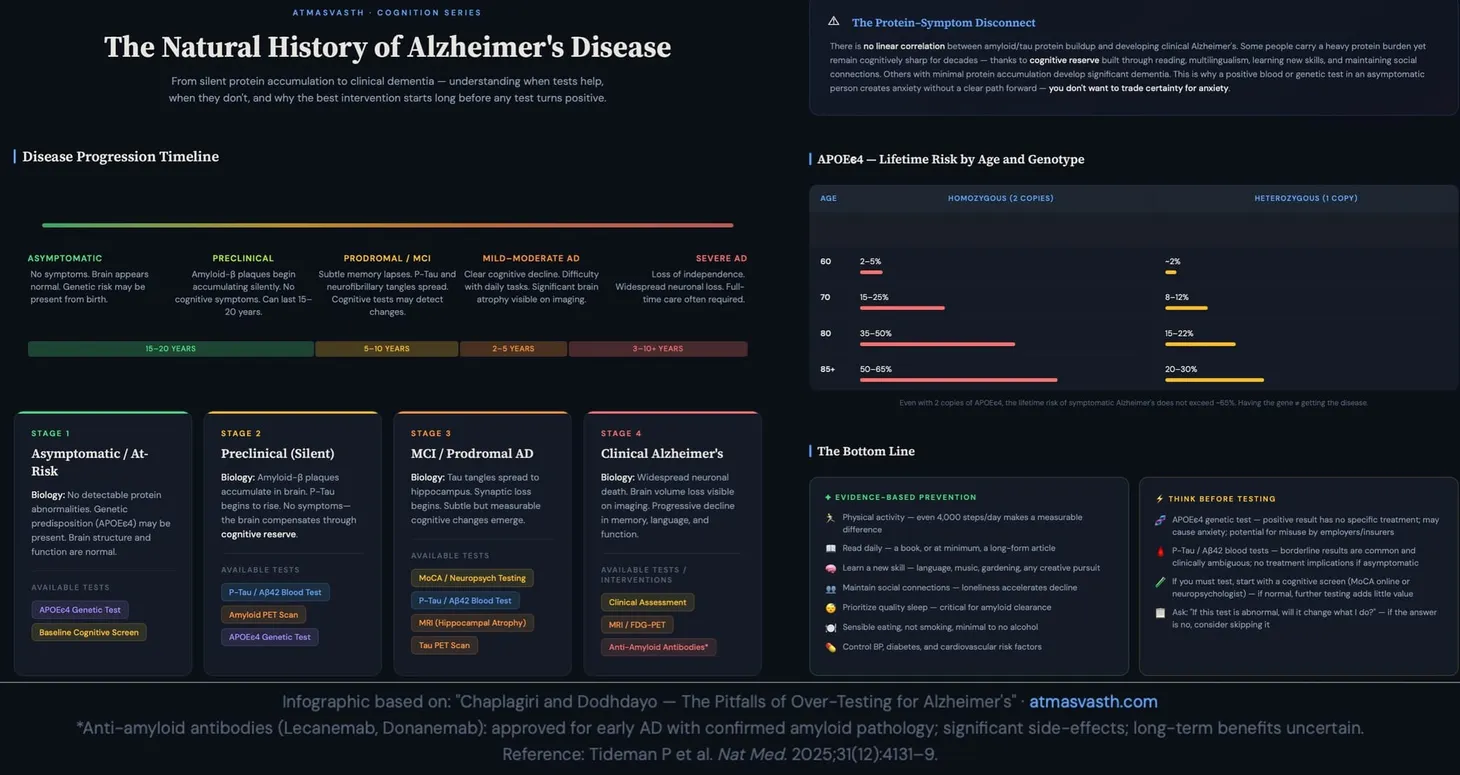
- Calm your mind and build cognitive reserves to prevent/delay cognitive decline/dementia — daily (meditation, downtime, learning, reading).
- Physical activity, good sleep, sensible eating, not smoking and minimal to no alcohol — help reduce cognitive decline. Specifically, 4000 steps a day make a difference.
- Read — preferably a book, else a long article, daily.
- Learn a new skill — language, musical instrument, singing, dancing, gardening, any creative experience makes a difference.
- Maintain social connections — to prevent loneliness, which can accelerate cognitive decline.
- Being multilingual builds cognitive reserves.
But what I haven't really addressed so far is cognitive bandwidth, “what we can sustain amid the complexity of real life — competing demands, emotional context, time pressure, and physiological stressors.”
Cognitive bandwidth rests on our fluid ability — the processing speed, working memory and ability to solve problems in real time — which slides downwards with age, as against crystallised ability, which is our vocabulary, judgement and all that we have learnt so far, and which holds steady or even keeps growing [2].
So while we may have adequate fluid ability in an ideal environment, when dealing with day-to-day issues, our overall cognitive bandwidth can slowly slide downwards and affect our ability to function mentally and to take reasonable decisions and actions. One of the reasons why the old are so susceptible to financial fraud is this — while navigating day-to-day activities, it becomes difficult to differentiate true from false, right from wrong, and you can become vulnerable to financial exploitation by people who either sweet-talk you or threaten you [3]. This is also the reason why older people and WhatsApp uncles and aunties tend to believe everything that is forwarded to them, whether true or false, right or wrong.
What can we do to manage the adverse effect of a sliding cognitive bandwidth?
- Do everything to maintain cognition, as in the 4th point.
- Identify and correct what can be corrected — poor sleep, specific stresses. And if the change is worsening rather than holding steady, see a doctor to rule out treatable causes such as thyroid problems, B12 deficiency, depression or medication side effects.
- Then take specific steps to address daily functioning:
A. Do one thing at a time as far as possible. One errand, one conversation, one task at a time. Jumping between or among multiple issues is where there is a real tax the brain and mind have to pay.
B. Do the hard thinking in the morning and avoid any major decision-making later in the day, including investment decisions and anything that can affect your physical, mental or financial health.
C. Externalise memory with lists, alarms and calendars. These crutches make a big difference. I use digital calendars and lists, but I also have a diary to write things down in, which is sometimes easier to look at, especially if I want to avoid “digital noise” during the day.
D. Anchor tasks to existing habits. If you need to make sure you take your medicines on time, anchor the act to something that is already a no-thinking habit, e.g. meals, or going for a walk, or going to work.
E. Work with recognisable patterns that don't need too much thought. I have specific things I wear to work and when going out that don't need my bandwidth to be stretched — so I don't have to tax my brain with decision-making about what to wear.
F. Speak to someone to get perspective and help…a friend, spouse, confidante or a coach. This will help sort out muddled thoughts and you will also realize that you are not alone.
As we grow old and find it difficult to multitask and do multiple things throughout the day equally well, whether it is morning, evening or night, we need to adjust our lives to cope and manage better.
Listening Options
Audio File
YouTube
Footnotes
- Stubberud J. The Invisible Load of Cognitive Symptoms. N Engl J Med 2026;395:6-7. DOI:10.1056/NEJMp2600769.
- Salthouse TA. When does age-related cognitive decline begin? Neurobiol Aging 2009;30:507-514. See also Salthouse TA. Consequences of age-related cognitive declines. Annu Rev Psychol 2012;63:201-226.
- Han SD, Boyle PA, James BD, Yu L, Bennett DA. Mild Cognitive Impairment and Susceptibility to Scams in Old Age. J Alzheimers Dis 2016;49(3):845-851. See also the Rush Memory and Aging Project work linking scam susceptibility to subsequent cognitive decline and dementia risk.
Atmasvasth Shop
 JPLLP
JPLLP
 JPLLP
JPLLP
The Detailed 15-Point Guide to Live Long, Healthy
 Bhavin Jankharia
Atmasvasth Newsletter
Join the newsletter to receive the latest updates in your inbox.