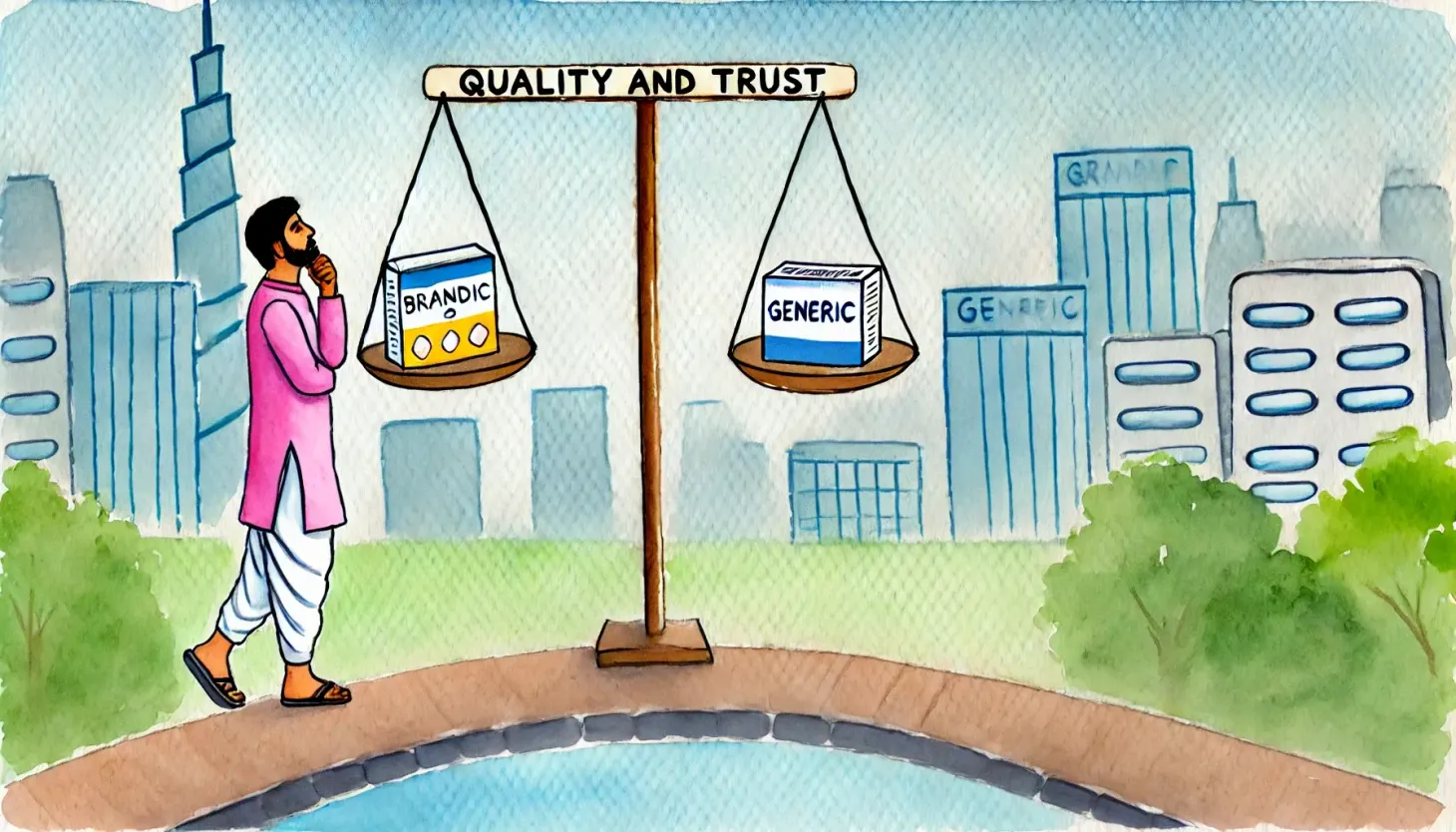
Maybe Where You Buy From Matters More Than Generic Versus Branded
It is probably more important where you buy the drugs from than what you buy in India
Audio and YouTube versions available at the end of this email.
Most of what I write about falls to the left of the health/disease line…primary and secondary prevention to either prevent disease from occurring in the first place or picking up disease early so that treating it can help us live long, healthy.
To the right of the line is advice on what to do if you do fall sick…and while atmasvasth is not about specific treatment options, I do look at the broader picture…for example, not getting operated for incidental findings like gallstones if you are asymptomatic, or asking the right questions before agreeing to any surgery, or checking every now and then whether you are taking too many unnecessary pills and avoiding self-prescription of antibiotics.
One such issue that I wrote about in Oct 2024 was about generic vs branded drugs, and my recommendation was under No 14
- Avoid generic drugs for all the pills you have to take. Use branded drugs from known companies.
A lot has happened in the last 2 years.
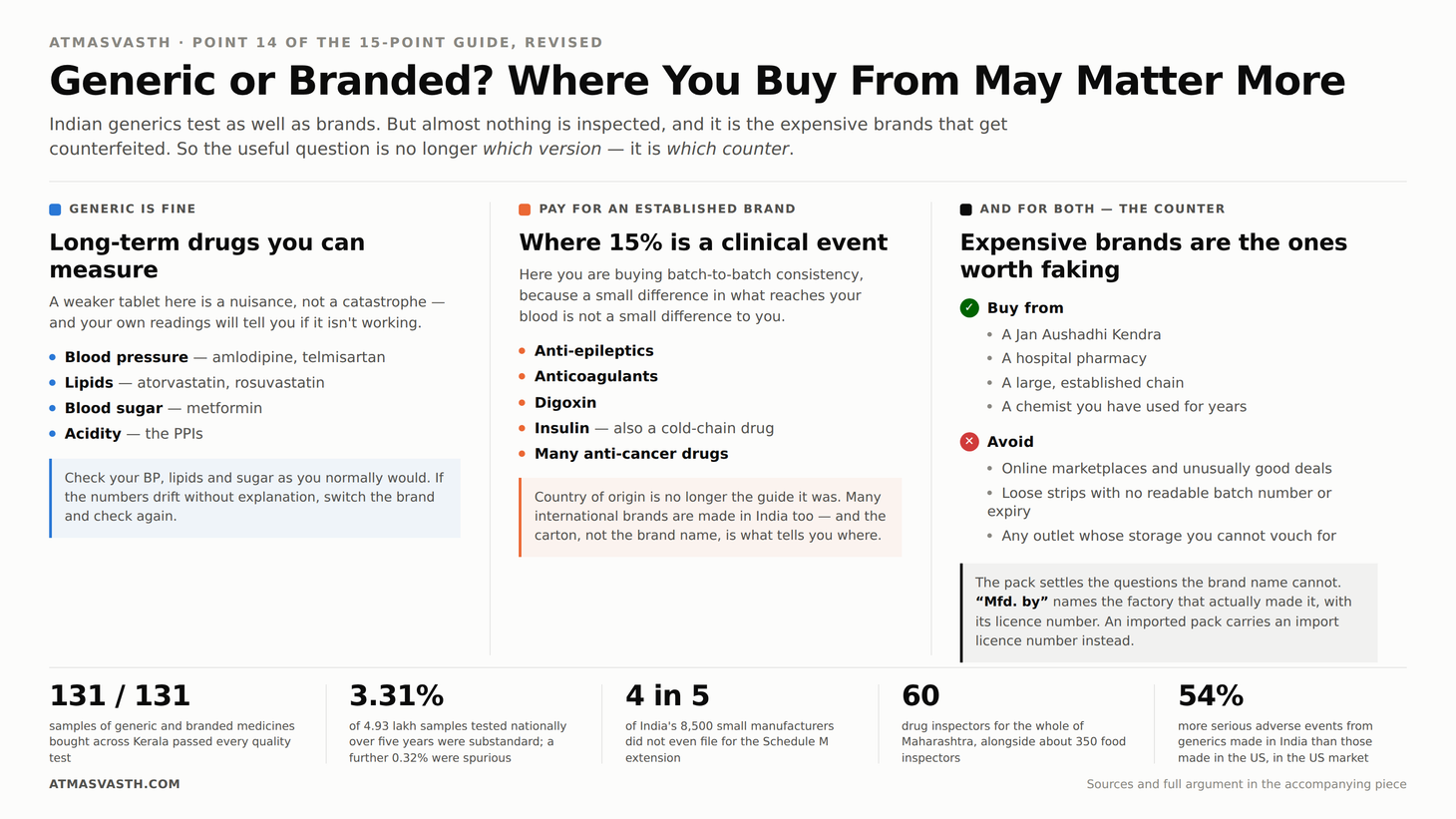
1. Dr. Cyriac Philips in Kerala and his colleagues tested 131 samples (22 different drugs across 8 categories) - both generics and branded - and found that all of them passed standard testing, suggesting that both generics and branded drugs in Kerala were good [1].
2. Of the approximately 4,93,104 samples tested over the five years from 2020-21 to 2024-25 - about 1.16 lakh a year - 16,342 (3.31%) were substandard and 1,593 (0.32%) spurious [2]. Now if you assume that billions of medicines are ingested or injected every day, even though the percentages are low, the number of substandard and spurious drugs likely runs into lakhs.
3. A study done by In Joon Noh and colleagues [3] showed that there were 54% more adverse events with generics manufactured in India and sold in the US versus generics made in the US, especially with older drugs where the profit margins were razor thin. Their explanation was that in such situations, Indian plants, whether owned by Indian companies or by international ones faced considerably less regulatory oversight [4]. One of the authors also testified in an American senate hearing about these findings.
4. Schedule M compliance. CDSCO (Central Drugs Standard Control Organization) has revised schedule M, which lays down specific standards that a drug making unit must adhere to. The around 8500 MSMEs, who generally make generics or are contract manufacturers for larger branded generic companies, were given until Dec 2025 to comply. 80% didn’t even fill up the form [5], which means we have no idea how compliant, if at all, these companies are.
5. Spurious drugs. Newspapers and other news sources regularly throw up reports of seizures and raids [6] that uncover spurious and counterfeit copies typically of expensive or popular brands, ranging from Keytruda (an anti-cancer drug) to Telma-AM, Glycomet, PAN-D, Shelcal [7] etc. Generics may be substandard but there is no money in counterfeiting them…so the more expensive and/or popular a branded drug, the higher the chance someone will make spurious copies.
6. Regulators. The Maharashtra FDA which has been in the news recently has to inspect everything from food establishments, to drug manufacturers to distributors to retailers and there is only so much they can do with the staff they have (approximately 60 drug and 350 food inspectors)…the vast majority of drug manufacturers may never be inspected.
So what does all this boil down to?
1. Even though the Kerala study showed that drugs across the spectrum from generics to branded seem to be equal, small scale drug manufacturers in India don’t seem to be CDSCO schedule M compliant and older generics made in India, sold in the US seem to be associated with higher adverse effects.
2. Branded drugs, whether international or Indian, especially expensive drugs or the best-selling ones are prone to counterfeiting.
My earlier advice was to use international brands, even if expensive, then Indian MNCs and only then generics. But perhaps the situation calls for some nuance.
There are many drugs, especially those taken long-term or for life, usually daily or weekly, where even if the generic drug is substandard (say only 85% bioavailability), the outcome will not be disastrous. These include drugs for blood pressure, lipid levels, and blood sugar control where regular measurement, which is under your control, will tell you whether they are working or not and you can always switch brands to confirm - drugs like rosuvastatin, atorvastatin, metformin, amlodipine, telmisartan, etc.
Then there are those where even a 15% difference in bioavailability can be life-threatening, e.g. insulin, anti-epileptic drugs, anti-coagulants, digoxin and many anti-cancer drugs. Here you need to buy an established brand, especially to ensure batch-to-batch consistency…and because counterfeiting is a real problem with these drugs, you need to buy from reputed stores, chains or hospital pharmacies and avoid any outlet, physical or online, where you are not sure of their genuineness and their storage facilities.
So, in practice, generics are fine for long term drugs, where the margin of error for substandard bioavailability is large, provided you buy them from reputed stores including Jan Aushadhi centres.
For other drugs. I had earlier written that we should prefer international (North American, Western European) brands to Indian brands, but quite a few international brands are also contract manufactured in India anyway, so unless you know for sure that the drug is being imported from a country or continent that has strict standards, it probably makes no difference which brand you buy as long as it is a well-known, recognized one, more importantly from known or established players to reduce the risk of spurious or counterfeit drugs.
In short, where you buy from is probably more important than whether you buy branded or generic.
Listening Options
Audio File
YouTube
Footnotes
1. Philips CA, Theruvath AH, Sreemohan A, Baby A, Jose S, Philips M, Philip T, Ramesh C. Pharmaceutical quality and cost-effectiveness of branded versus generic medicines across 22 drug types and 8 therapeutic categories: a citizen-funded comparative study from regulated retail outlets in Kerala, India. Front Pharmacol. 2026 Jun 3;17:1799574. doi: 10.3389/fphar.2026.1799574. PMID: 42318332; PMCID: PMC13273042.
2. https://www.newkerala.com/news/a/nearly-lakh-drug-samples-tested-five-years-ensure-759.htm
3. Noh, I. J., Gray, J., Ball, G., Wright, Z., & Park, H. (2025). Are All Generic Drugs Created Equal? An Empirical Analysis of Generic Drug Manufacturing Location and Serious Drug Adverse Events. Production and Operations Management, 34(9), 2601-2617.
 JPLLP
JPLLP
 JPLLP
JPLLP
The Detailed 15-Point Guide to Live Long, Healthy
 Bhavin Jankharia
Atmasvasth Newsletter
Join the newsletter to receive the latest updates in your inbox.