Most of Us Sleep at the Bottom Edge of Normal
Most of us don't sleep enough and this has consequences.
Audio and YouTube versions available at the end of this email.
In the 15-point Atmasvasth guide to live long healthy, both in the book and the zine, my sleep recommendation is as follows:
- Sleep for at least 6-8 hours a day.
- Daytime naps of 30-45 minutes help.
- If you snore or feel groggy during the day, see your physician and if necessary, a sleep specialist. Do not however do a sleep test if you are otherwise normal.
Nothing much has changed since then but some more robust data has been published in the interim that helps us understand these issues better.
I am not a fan of the Oura ring, mainly because I don’t really want to wear a device 24/7. Even my Apple Watch is used only during workouts and runs. I don’t think devices need to know what I am doing every second of my life. But thankfully for those of us who love looking at and analyzing health related data, Indians and others who wear Oura rings have helped us understand sleep patterns of almost 2,20,000 people in 35 countries over 50 million recorded nights. Though the data does apply to those who can afford an Oura ring, which is basically this readership, it gives a sense of sleep patterns in India compared to the rest of the world.
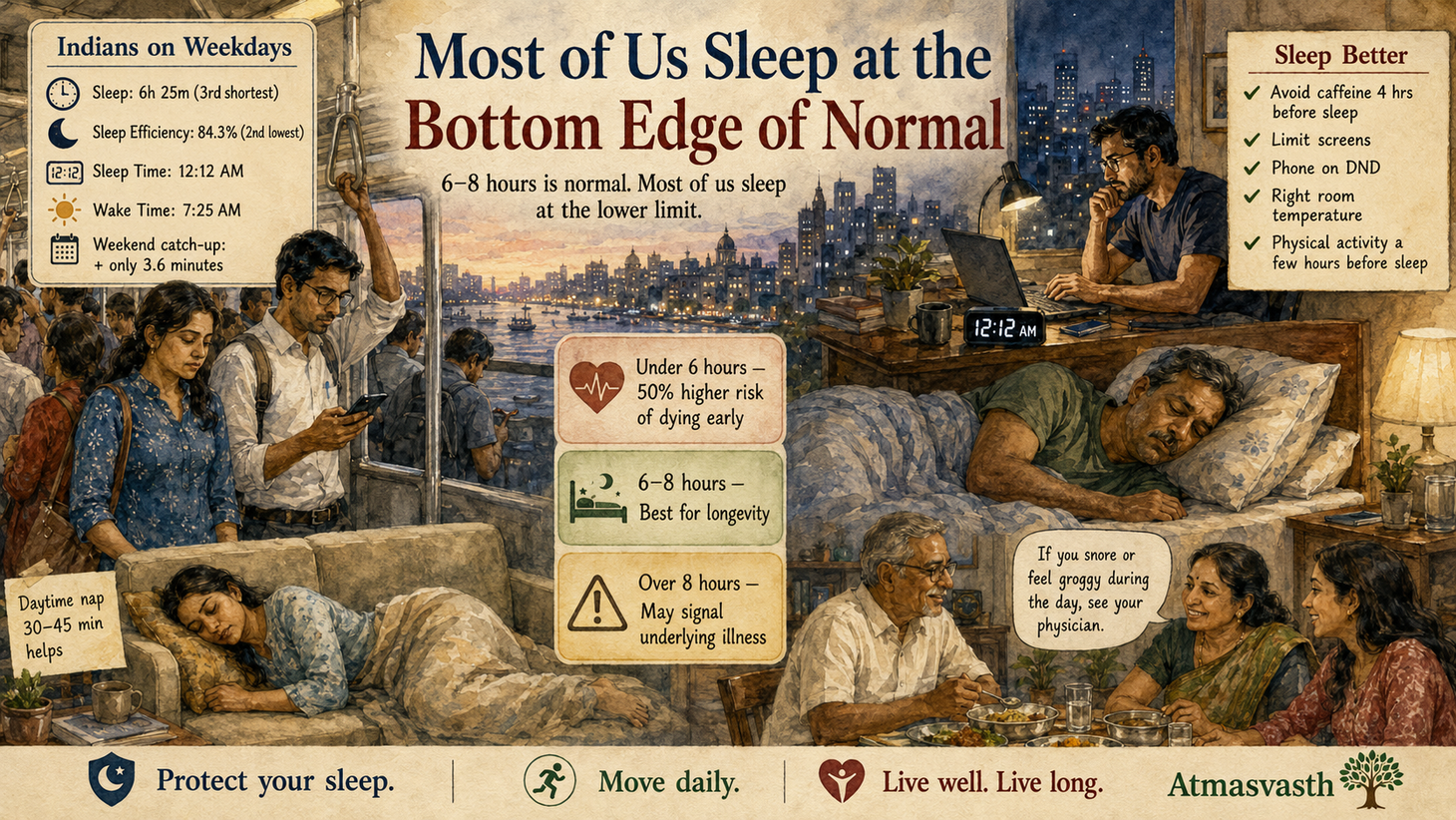
This was a study in 2023 published by Michael Chee in Sleep Medicine [1]. Indians sleep 6 hours and 25 minutes on weekdays, the third shortest sleepers in the world behind Japan (6 hours 6 minutes) and South Korea (6 hours 19 minutes), New Zealanders being the longest sleepers at 7 hours and 4 minutes. Indians also have a poorer sleep efficiency at 84.3% (the amount of time actually spent sleeping), which is the second lowest in the world. We also sleep late (12:12 AM), but wake up at 7:25 AM like most people in the world because of the need to go to work and this causes a significant sleep debt. While many people in the Western countries try to compensate by sleeping longer over weekends, this does not apply to Indians, who sleep an average of just 3.6 minutes longer on weekends.
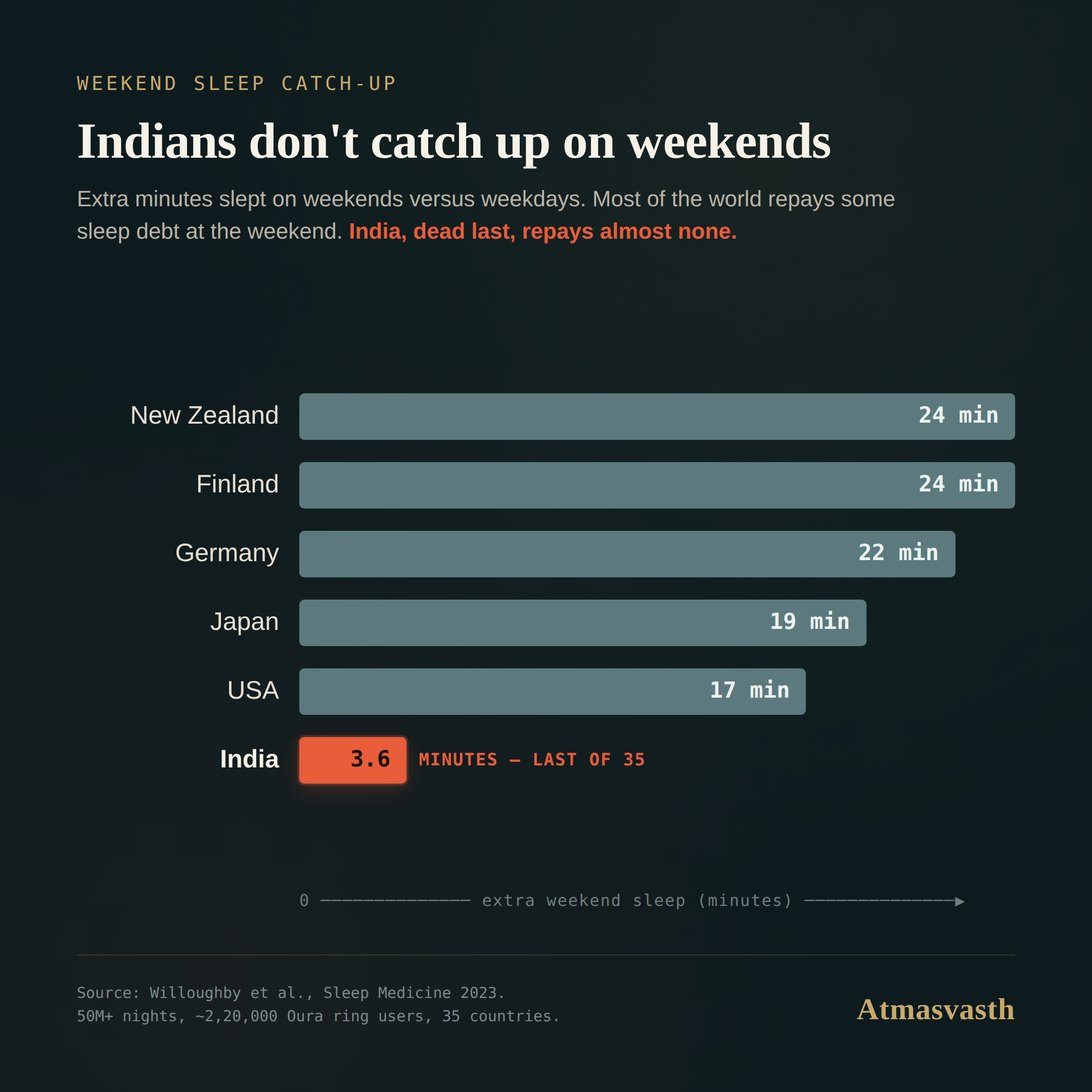
All of this just reinforces what I have said earlier, that most people seem to sleep at the lower limit of the normal 6-8 hours.
 Bhavin Jankharia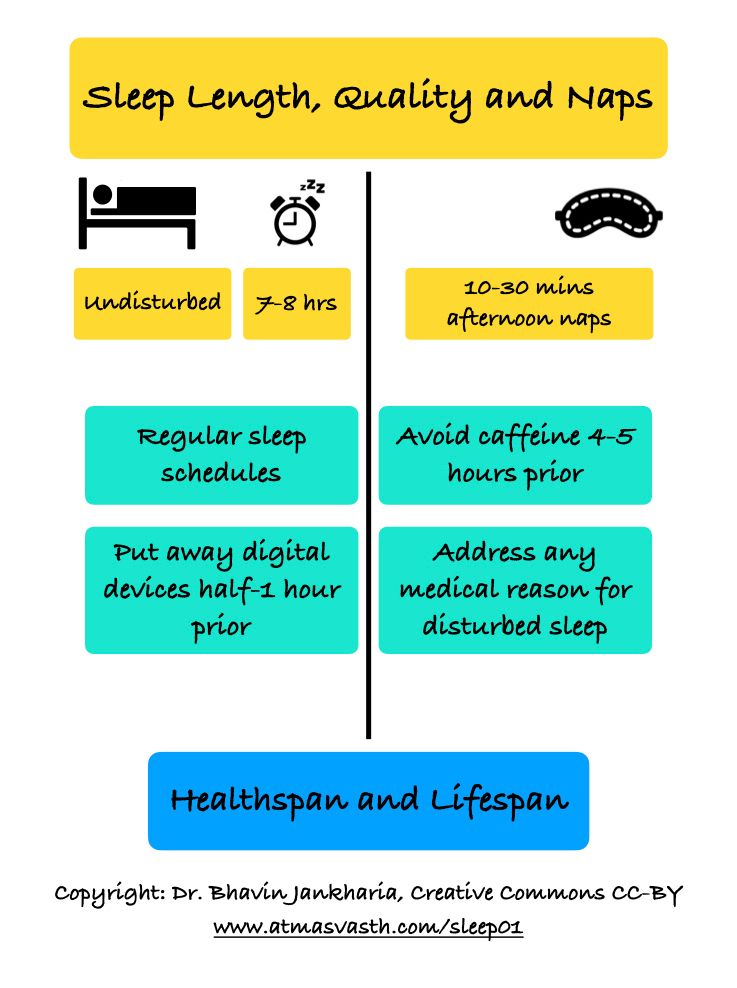
This was also reinforced by the 2024 analysis of the Longitudinal Ageing Study in India (LASI) cohort, covering 59,441 Indians aged 45 and older [2]. 11.7% Indians over 45, have sleep issues.
The two papers are different, the first uses objective Oura ring data and the 2nd was a one-time survey of self-reported issues but it does tell us the scale of the problem.
Does this matter?
In May 2026, Nature published the largest multi-organ study of sleep and biological ageing ever conducted [3]. The authors looked at 5,00,000 (5 lakh) UK Biobank adults between 37 and 84 years of age and checked the effect of sleep on biological ageing clocks (we have discussed the concept of biological clocks a couple of times in the last month).
 Bhavin Jankharia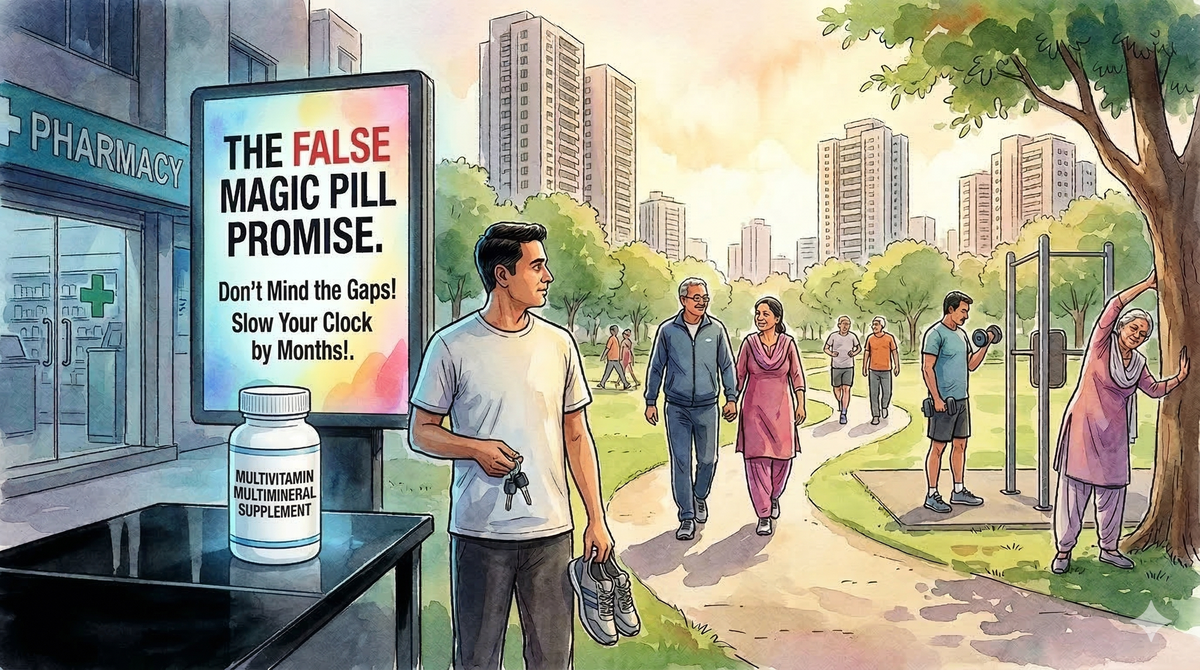
 Bhavin Jankharia
They found that sleep duration of less than 6 hours was associated with a 50% higher risk of dying from all causes compared to those who slept between 6 and 8 hours. Those who slept longer also had a higher risk of dying but that was more likely because of an underlying disease process that produced excessive sleep as a symptom of that disease.
Which was also what another study published in April 2026 in JAMA Network Open [4] said about excessive daytime sleeping. They found that excessive daytime sleeping was associated with poorer outcomes, mainly in those with cognitive issues, likely because the underlying health issues caused the person to doze off during the day at odd hours. This was twisted by the lay press to imply that daytime naps are harmful, and that could not be further from the truth. There is however, no new good data on daytime naps since the last time I wrote about the “baporiyu”.
 Bhavin Jankharia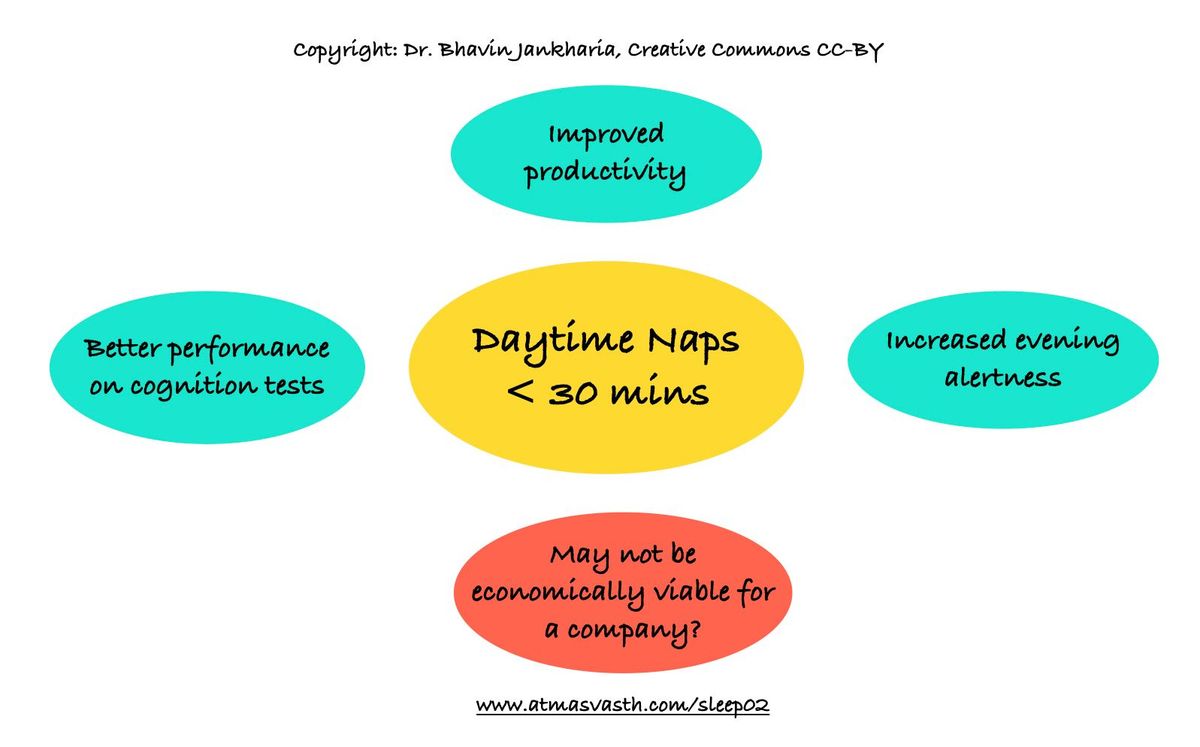
Does it help to track sleep with devices, like say tracking calories a few days a month? While devices like the Apple Watch are wonderful currently at catching heart rhythm problems, there just still isn’t good data (despite the Oura ring based study) that they help or make a difference. It may be best to just check your “bed in-bed out time” and how you feel when you wake up to get a sense of whether you are sleeping well or not.
 Bhavin Jankharia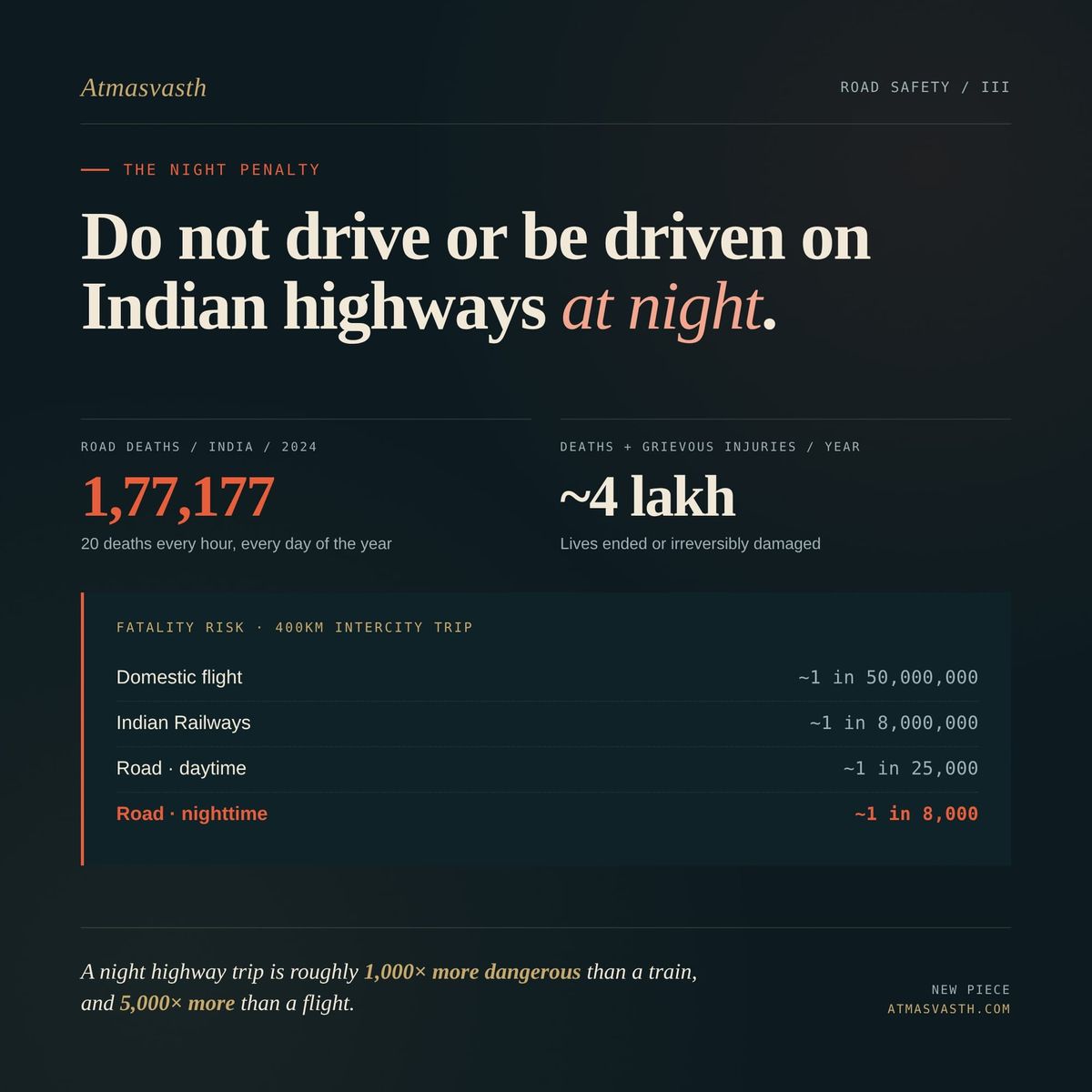
So what does this mean for you and me?
If you sleep less than 6 hours a day, you need to figure out a way to sleep longer, either by adding a daytime nap or sleeping more over weekends or simply just “sleeping at least a half hour longer”.
Daytime naps are fine.
However, if you find yourself or those around you sleeping for more than 8 hours a day or dozing off at odd hours, then that may be a symptom of an underlying disease process, which should be investigated for.
I had written up some pointers in the book for sleeping better…but somehow the list never made it to the website. This list is a guide. If you are anyway sleeping well, then just do what you normally do. If you are not sleeping well, then these points may help.
- Avoid caffeine before sleep - the duration may vary - for me it is not less than 4 hours from my time of sleep, for e.g. if I sleep at 9.30 PM, then my last intake of caffeine in any form would be not later than 5.30 PM. You can experiment and find your last caffeine limit, but then stick to it.
- Avoid screens. While this is being drummed into our heads, the data is not very strong. I know many people, who are able to go to sleep well, despite spending the last 10-15 minutes on their phones or IPADs, reading, scrolling through messages or playing games. You have to figure out what works for you. If the device stresses you out because of what you are reading or if you are doomscrolling, then you are perhaps better of reading a physical book, else it probably does not matter.
- Phone calls are an issue. Unless you are on call as a doctor or an emergency contact, it is best to put the phone on Do Not Disturb or Silent. Any phone call while sleeping will pretty much destroy your sleep quality.
- The room temperature. Unless you are so tired that you just crash and it makes no difference, the ambient temperate matters. If it is too hot or too cold or if the fan is too strong, or if the air conditioner is set too high or low…these can all make a difference and you will have to find your sweet spot here.
- Physical activity, a couple of hours or so prior to your sleep time will help you sleep.
Listening Options
Audio File
YouTube
Footnotes
1. Willoughby AR, Alikhani I, Karsikas M, Chua XY, Chee MWL. Country differences in nocturnal sleep variability: Observations from a large-scale, long-term sleep wearable study. Sleep Medicine 2023;110:155-165.
2. Sreepada SS, Halder P, Amudhamozhi KS, Soni V, Sharma H, Rathor S. Prevalence of sleep disorders and association with various occupations among Indian population aged ≥ 45 years: Insight from Longitudinal Ageing Study in India (LASI). J Family Med Prim Care 2024;13:4208-16.
3. The MULTI Consortium et al. Sleep chart of biological ageing clocks in middle and late life. Nature 2026. doi:10.1038/s41586-026-10524-5.
4. Gao C, Cai R, Zheng X, et al. Objectively Measured Daytime Napping Patterns and All-Cause Mortality in Older Adults. JAMA Network Open. 2026;9(4):e267938.
Atmasvasth Shop
 JPLLP
JPLLP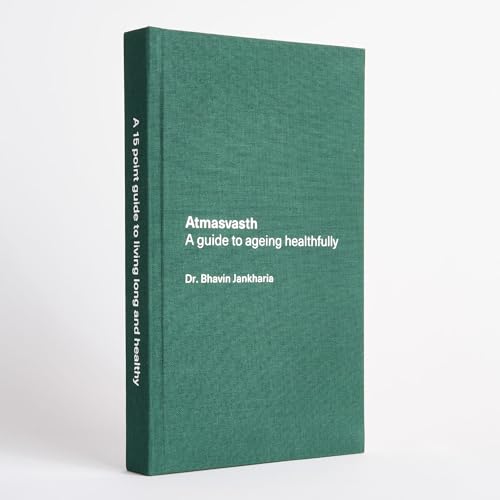
 JPLLP
JPLLP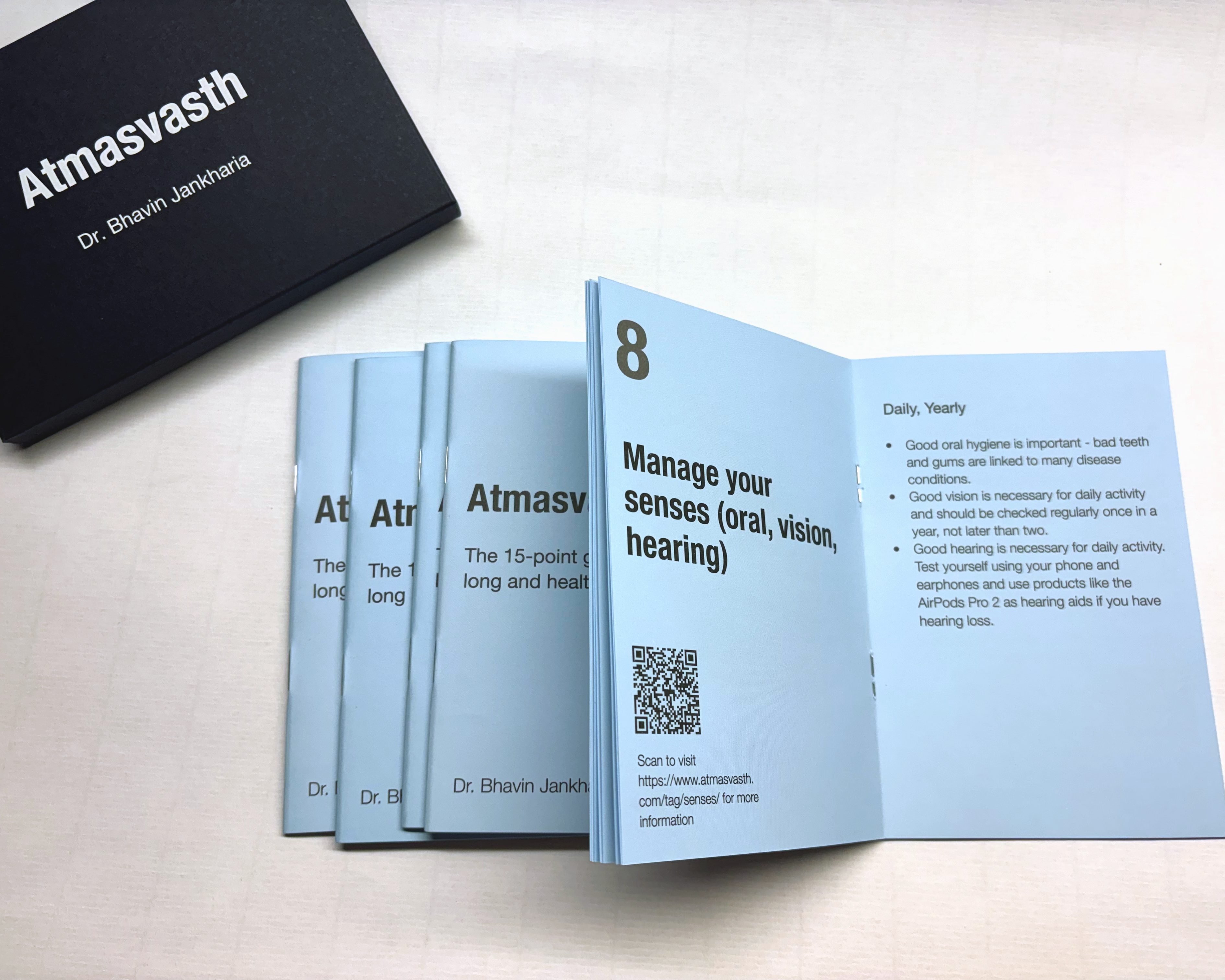
The Detailed 15-Point Guide to Live Long, Healthy
 Bhavin Jankharia
Atmasvasth Newsletter
Join the newsletter to receive the latest updates in your inbox.