Improving Cardiorespiratory Fitness...1 MET at a Time
Improving cardiorespiratory fitness (VO2 max) 1 MET at a time improves healthspan and lifespan
Audio and YouTube versions available at the end of this email.
My first point in the 15-point atmasvasth guide to live long, healthy is
1. Move - be physically active - daily.
The 5th subpoint (which I have now moved up to the 3rd subpoint) is
- If you are already active, then improve your cardiorespiratory fitness (CRF) to the appropriate level for your age by increasing the level / amount of your physical activity. You can measure your CRF using your tracking device (Apple Watch, etc) or with a treadmill stress test.
Physical activity accounts for a third of what we can do to prevent disease (along with food, sleep, vaccines, not smoking, not drinking, etc).
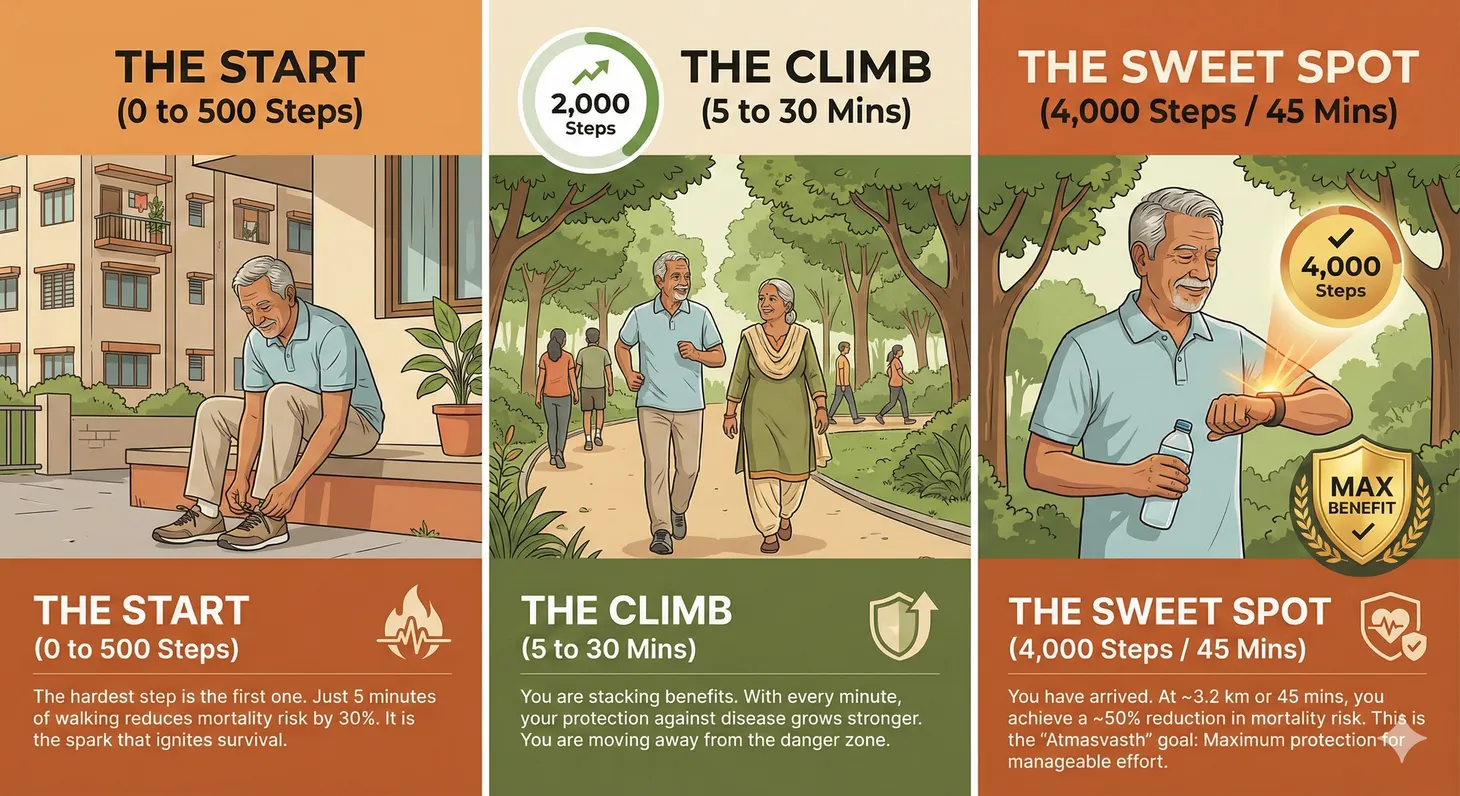
I wrote about CRF in Sep 2022, but have never really pushed it much, simply because it is easier to tell people who are not physically active to walk 30-45 minutes a day (4000 steps a day) than to start running or pushing themselves.
But among those who are already physically active, the higher the CRF, the better they do in life.
You don’t need a collection of fancy rings, watches and devices to improve your healthspan and lifespan…they can track, but can’t do the work for you, which is…working out regularly and daily.
Why does CRF matter?
CRF describes how well the heart, lungs and muscles work together to support sustained physical activity. It is commonly expressed as VO₂ max — the maximum amount of oxygen the body can use during intense exercise — in millilitres per kilogram of body weight per minute.
We can express this as METs, or metabolic equivalents, by dividing VO₂ max by 3.5. One standard MET represents approximately the oxygen used at rest. METs can describe both the effort required for an activity and the maximum exercise capacity a person can achieve.
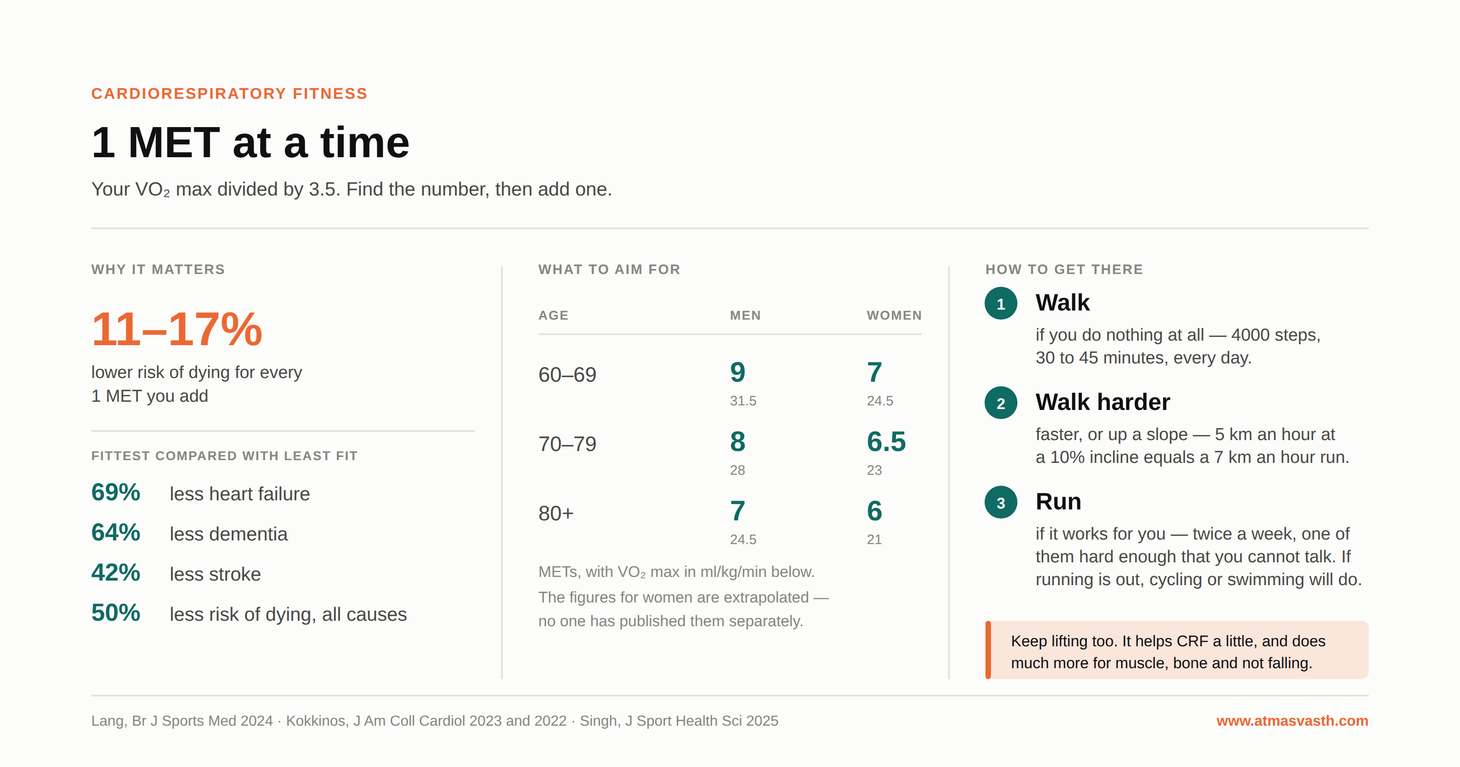
Justin Lang and colleagues [1] in 2024 put together 26 reviews that between them covered 199 studies and 20.9 million or over two crore observations…which is a lot of data by any standard. Those with high CRF, compared to those with low CRF, had 69% less heart failure, 64% less dementia, 42% less stroke and kidney disease, 40% less atrial fibrillation, 39% less depression and roughly half the risk of dying of anything at all. For every one MET that you add, the risk of dying drops by 11 to 17%.
And this is modifiable. Peter Kokkinos and colleagues [2] put 93,060 veterans on a treadmill twice, a few years apart, and those who had improved by more than 2 METs between the two tests cut their risk of dying by up to a third, while those who had lost more than 2 METs raised it by about 69-74%, depending on whether they had cardiovascular disease or not.
Where am I?
In Sep 2022, when I wrote the CRF piece, my VO2 max was 37 ml/kg.min (MET of 10.6), which for a 57-year old meant I was fit, but not highly fit. I measure my VO2 max (it happens automatically after every run) with my Apple watch, which uses a complex proprietary algorithm and there is now data that suggests that this is good enough [3]. Even if the number is a little off compared to a treadmill stress test with breathing gas analysis, the error tends to be consistent for the same person, so the trend stays reliable.
I am now 61 and I run twice a week (zone 1, zone 2, tempo is the rhythm) and workout thrice a week with a trainer and with family (wife and one of the kids) and my VO2 max as of today is 32.46 ml/kg.min down because of the humidity and heat from last winter’s high of 34.68 ml/kg.min. This Dec-Jan, when the runs become longer and faster as the humidity drops, I will probably get there again.
So 32.46 ml/kg.min is now 9.3 METs, which makes me fit for a 60-plus individual, but not highly fit.
So how does one get there?
It starts with walking. 4000 steps a day for a 60 year old man will be around 8 METs and you need to get to 9-12. For a woman of the same age, the same 4000 steps will mean 6.5 METs, and her target would be 7 to 9 (this is an extrapolation from the male data…no one has published female targets separately) [4].
More walking will not get you there. A brisk walk, however long you do it for, takes your heart to only about half of what it is capable of. The MET number moves only when you go close to the top of what you have, which means breathing hard enough that you cannot finish a sentence. Walking, for most of us, will never do that, and that is where running comes in. Twice a week is enough, which is what I do, but one of those two runs has to be hard, because the easy run only maintains what you already have and it is the hard one that pushes the number up.
A lot of people over 60 cannot run, or should not run, because of the knees or the back or the hips, and for them the answer is to put the treadmill on an incline, because a slope also gets the heart rate up at a walking speed that is manageable. Five km an hour at a 10% incline is similar to a 7 km an hour run, without any of the pounding.
So, once a week, warm up for five minutes on the flat, then do four rounds of two minutes at 5 km an hour and a 10% incline with two minutes of flat walking in between, and over the next two to three months stretch those two minutes to four. If there is no treadmill, then a flyover, any decent slope or a staircase will do the same job.
And if you just can’t do inclines, then swimming or cycling (stationary or on the road) should work as well.
And strength training?
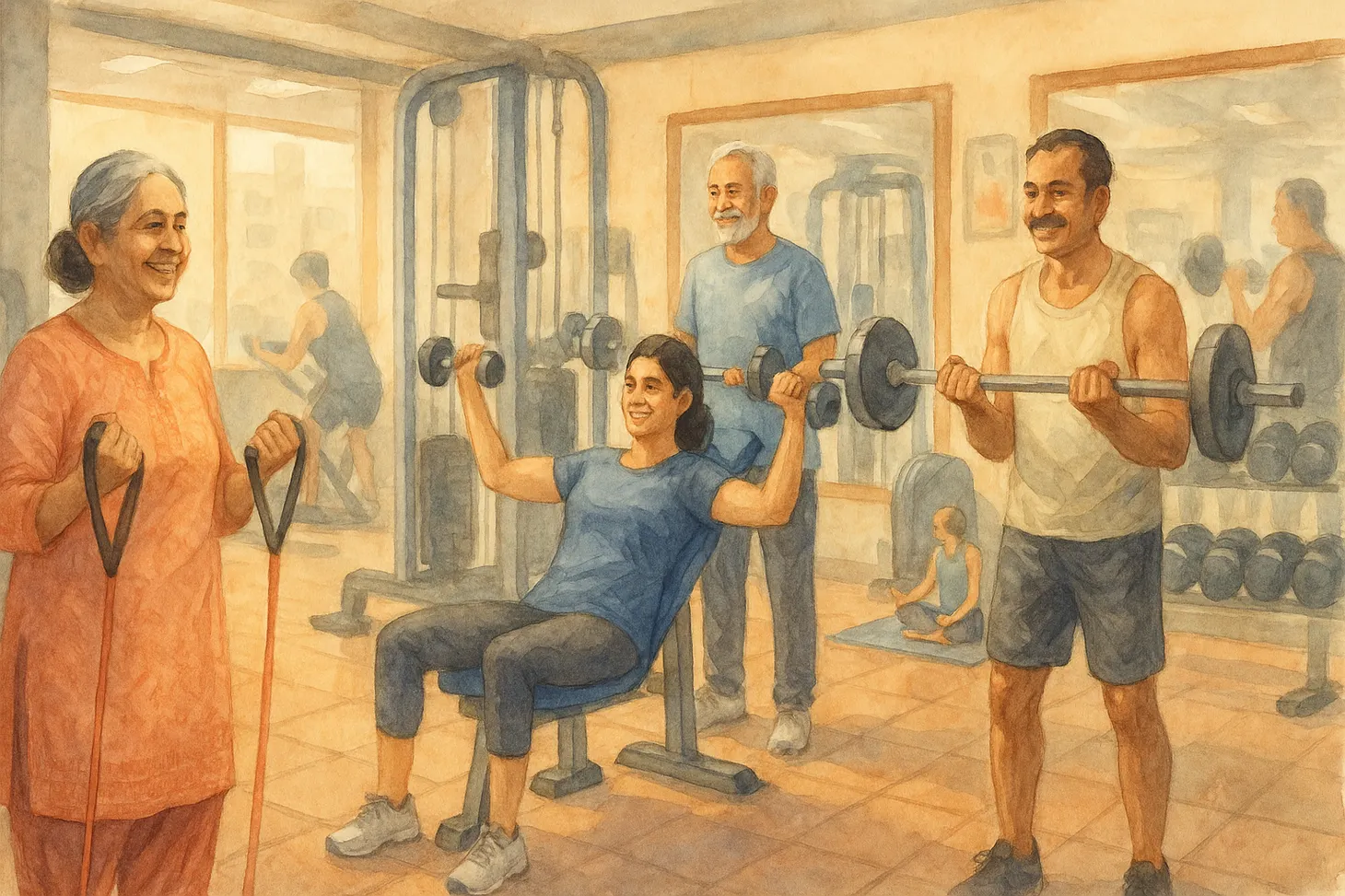
You also need to keep lifting. Strength training also improves CRF, but more importantly, it builds muscle, strengthens bones and reduces the adverse effect of falls, if not preventing falls and this is equally important.
In short…

Walk if you don't do anything. Increase the speed or incline once you start walking. Run if it works for you. If you can't run or use an incline, cycling or swimming are also fine.
What gets measured, gets managed, even if it is pointless or harmful [5]. In medicine, we focus on high blood pressure, high blood sugar, high lipid levels, partly because they are measurable and their change with medicines can be tracked (the pointless ones are often tracking vitamin or mineral levels, sleep data and other similar foo-foo parameters, especially when we don’t have any clinical disease or reason to do so).
Physical activity, the single most important intervention to live long healthy, has never had similar measurements, but the VO2 max can act as one. So measure it on your device (Apple Watch, Garmin, etc), track it, and see how you are doing.
Try to get to 9 METs (VO2 max - 31.5) if you are over 60, to 8 (VO2 max - 28) if you are over 70 and 7 (VO2 max - 24.5) after that, if you are a man…for women, the target is 2 METs lower (VO2 max - 24.5 above 60), 6.5 METs over 70 (VO2 max - 23) and 6 METs over 80 (VO2 max - 21), with the caveat that the numbers in women are extrapolations [4]. You don’t need any other fancy method.
Just work towards improving your CRF…1 MET at a time.
Footnotes
1. Lang JJ, Prince SA, Merucci K, et al. Cardiorespiratory fitness is a strong and consistent predictor of morbidity and mortality among adults: an overview of meta-analyses representing over 20.9 million observations from 199 unique cohort studies. Br J Sports Med. 2024;58(10):556-566.
2. Kokkinos P, Faselis C, Samuel IBH, et al. Changes in cardiorespiratory fitness and survival in patients with or without cardiovascular disease. J Am Coll Cardiol. 2023;81(12):1137-1147.
3. Singh B, Cadenas-Sanchez C, da Costa BGG, et al. Comparison of objectively measured and estimated cardiorespiratory fitness to predict all-cause and cardiovascular disease mortality in adults: a systematic review and meta-analysis of 42 studies representing 35 cohorts and 3.8 million observations. J Sport Health Sci. 2025;14:100986.
4. Kokkinos P, Faselis C, Samuel IBH, et al. Cardiorespiratory fitness and mortality risk across the spectra of age, race, and sex. J Am Coll Cardiol. 2022;80:598-609.
5. Centre for Public Impact. "What gets measured gets managed" — it's wrong and Drucker never said it. Medium, 2020. https://medium.com/centre-for-public-impact/what-gets-measured-gets-managed-its-wrong-and-drucker-never-said-it-fe95886d3df6
Listening Options
Audio File
YouTube
 JPLLP
JPLLP
 JPLLP
JPLLP
The Detailed 15-Point Guide to Live Long, Healthy
 Bhavin Jankharia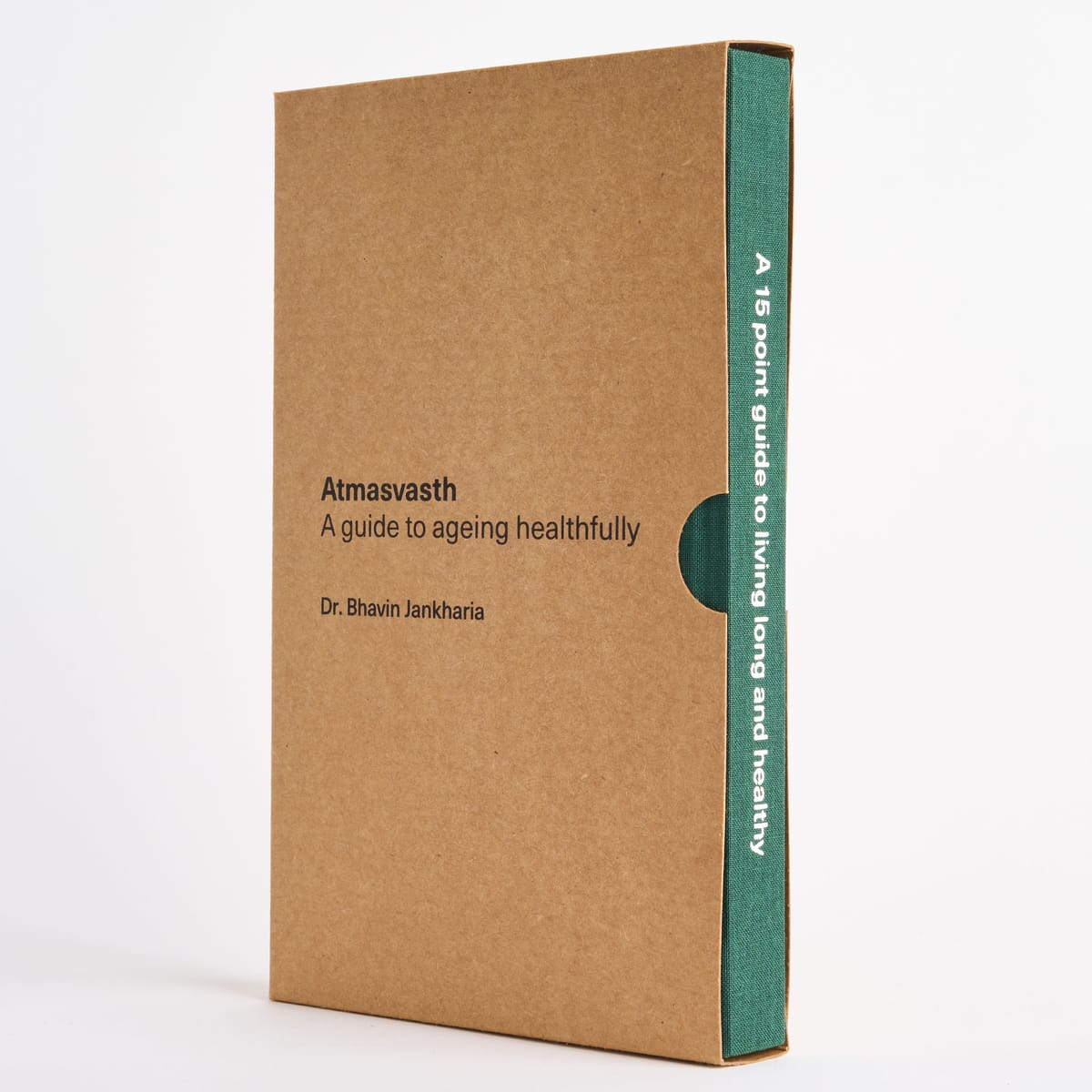
Atmasvasth Newsletter
Join the newsletter to receive the latest updates in your inbox.